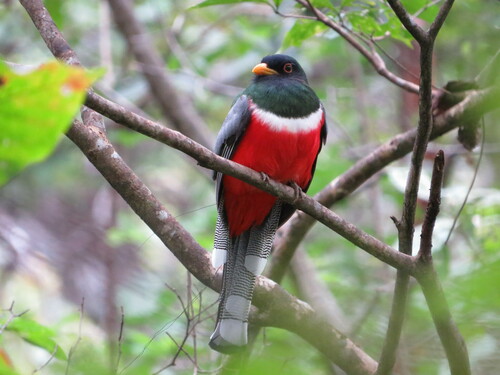
Elegant Trogon
Trogon elegans
With its iridescent green plumage and startling red belly, the Elegant Trogon is a tropical masterpiece that graces the canyons of the Southwest and Central America. A favorite among birders, this elusive 'mountain parrot' is a testament to the hidden beauty of the riparian forest.
Quick Identification
Size
Length: 28-30 cm (11-12 in); Wingspan: 35-40 cm (14-16 in); Weight: 60-80 g (2.1-2.8 oz)
Colors
Males feature iridescent metallic green upperparts, a black face and throat, and a brilliant red belly separated by a crisp white breast band. Females are brownish-gray where the male is green, with a small white 'teardrop' patch behind the eye.
Key Features
- Iridescent green or gray-brown upperparts
- Bright rose-red underparts with a white horizontal chest band
- Long, squared-off tail with coppery-bronze feathers
- Yellow bill and distinct black facial mask
When You’ll See Them
Geographic range
Where Does the Elegant Trogon Live?
This stunning species is a crown jewel of the North American birding world, primarily inhabiting the tropical and subtropical regions of Central America. From its southern reaches in Costa Rica and Guatemala, its range extends northward through the mountain chains of Mexico, reaching its northernmost limit in the rugged canyons of southeastern Arizona and southwestern New Mexico. These northern populations represent a highly sought-after specialty for birders in the United States, where the birds favor shaded, sycamore-lined riparian corridors during the breeding season.
Basemap © OpenStreetMap contributors
Behavior
Elegant Trogons are often described as 'still-hunters.' They spend significant amounts of time perched motionless on mid-canopy branches, scanning the surrounding foliage for movement. When prey is spotted, they execute a sudden, acrobatic sally to pluck an insect or fruit before returning to a perch, often a different one than they started from. Despite their vibrant colors, they are surprisingly difficult to spot until they move or give their distinctive, barking 'co-ah, co-ah' call.
These birds are largely solitary or found in pairs during the breeding season. They are cavity nesters but lack the strong bills of woodpeckers; instead, they rely on pre-existing holes in rotting trees or abandoned woodpecker nests, which they may slightly enlarge by 'gnawing' at the wood. While they are generally shy and avoid high-traffic human areas, they can become somewhat accustomed to quiet observers in popular birding canyons.
EverydayEarth exclusive
Camera Tips
To capture an Elegant Trogon on an AI-powered camera, placement is the most critical factor. These birds occupy the mid-story of the forest, rarely descending to the ground. Position your camera 8 to 15 feet high, ideally strapped to a tree overlooking a horizontal branch that serves as a natural 'lookout' post. If you are in the Southwest US, look for large Arizona Sycamores near creek beds; trogons frequently return to the same perches in these trees to scan for insects.
While they won't visit standard bird feeders, you can attract them to your camera's field of view by focusing on water sources or fruiting shrubs. In arid canyon environments, a secluded dripping birdbath or a natural pool in a shaded wash is an irresistible draw. Alternatively, aim your camera at wild grapes, hackberries, or madrone trees when they are in fruit, as trogons will hover-glean these berries, providing excellent action shots.
Adjust your camera settings for high-speed capture. Trogons are famous for sitting perfectly still for minutes and then moving with lightning speed. A fast trigger speed and a high-frame-rate video setting (at least 60fps) are necessary to catch the moment they take flight. Because they live in high-contrast environments with bright sun and deep shadows, use a camera with good dynamic range or place it in a consistently shaded area to avoid 'blown-out' highlights on their white breast bands.
Similar Species
Species that look similar or are commonly confused with Elegant Trogon.
Mountain Trogon
Features more prominent black-and-white barring on the outer tail feathers and inhabits higher elevation forests in Mexico.
Eared Quetzal
Much larger with a shaggy crest and lacks the white breast band found on the Elegant Trogon.
Citreoline Trogon
Easily distinguished by its bright yellow belly instead of the Elegant Trogon's red belly.
Frequently Asked Questions
Record Elegant Trogon at your habitat
Connect a camera to start building your own species record — AI identifies every visitor automatically.