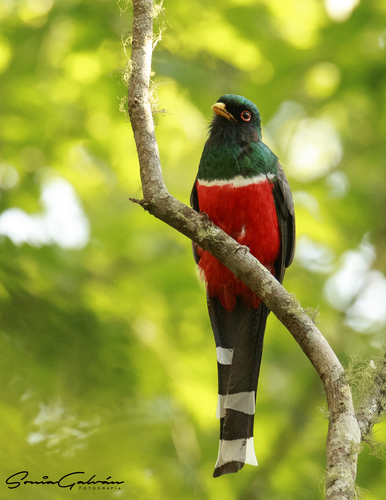
Mountain Trogon
Trogon mexicanus
With its brilliant red breast and iridescent green plumage, the Mountain Trogon is a crown jewel of the pine-oak highlands. Often called the Mexican Trogon, this elusive bird brings a touch of tropical splendor to the cool, misty mountain air.
Quick Identification
Size
29–31 cm (11.5–12 in) in length; wingspan of 38–43 cm (15–17 in); weighs 70–80 g (2.5–2.8 oz)
Colors
Males are metallic green on the head and back with a bright red belly and a white breast band. Females are warm brown on the head and back with a red lower belly.
Key Features
- Distinctive white horizontal breast band
- Vibrant red belly and undertail coverts
- Square-tipped tail with fine black-and-white barring
- Metallic green (male) or warm brown (female) upperparts
When You’ll See Them
Geographic range
Where Does the Mountain Trogon Live?
Native to the highland regions of North and Central America, the Mountain Trogon is primarily found throughout the central and southern mountains of Mexico. Its range extends southward through the rugged interior of Guatemala and into the northern highlands of Honduras. While it is a permanent resident in these mountainous corridors, it occasionally appears as a rare vagrant in the sky islands of the southern United States and parts of El Salvador.
Basemap © OpenStreetMap contributors
Behavior
The Mountain Trogon is a relatively sedentary bird, often spending long periods perched motionless on horizontal branches in the mid-to-upper canopy. This "sit-and-wait" behavior makes them somewhat difficult to spot despite their bright colors, as they blend into the dappled light of the forest. When they do move, they perform short, fluttering flights to snatch insects from foliage or pluck berries from branches, often hovering briefly mid-air with a distinctive audible wingbeat.
Socially, they are usually found singly or in pairs and are highly territorial during the breeding season. They are known for their vocalizations, which consist of a series of low, hollow barking notes that can echo through the misty highlands. While they are generally shy and avoid direct interaction with humans, they are not particularly flighty and may allow a patient observer to watch them if they remain still and quiet.
EverydayEarth exclusive
Camera Tips
Capturing a Mountain Trogon on camera requires focusing on the mid-story of the forest, typically between 3 and 10 meters above the ground. These birds prefer horizontal, unobstructed branches as hunting perches. If you are placing a camera in a backyard that borders highland woods, look for native fruiting trees—especially wild avocados or other members of the Lauraceae family. Trogons are highly attracted to these fruits and will return to the same tree daily until the fruit is gone.
Because trogons are "sit-and-wait" predators, they can remain perfectly still for several minutes at a time. This behavior often fails to trigger standard motion sensors on trail cameras. To overcome this, use a high-sensitivity setting or a time-lapse mode that takes a photo every 30 to 60 seconds during the morning hours. If your camera has a "hybrid" mode, set it to take a high-resolution photo followed by a short video clip to capture the bird's unique hovering feeding motion.
Lighting is a major challenge in their preferred habitat, which is often misty or densely shaded. Position your camera facing north or south to avoid direct sun flare, and try to frame a branch that receives consistent dappled light. During the spring breeding season (March through June), look for old woodpecker holes in decaying pine or oak trees. Placing a camera at a safe distance from a potential nesting cavity can provide incredible footage of the pair bringing insects to their young, though you must ensure the equipment is well-camouflaged to prevent disturbing them.
Similar Species
Species that look similar or are commonly confused with Mountain Trogon.
Frequently Asked Questions
Record Mountain Trogon at your habitat
Connect a camera to start building your own species record — AI identifies every visitor automatically.