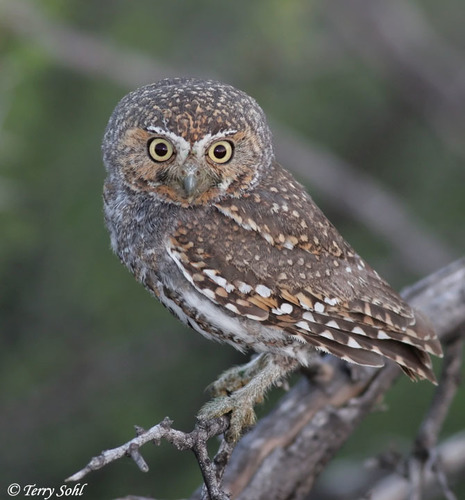
Elf Owl
Micrathene whitneyi
The Elf Owl is the world's smallest owl, a sparrow-sized desert specialist that makes its home in the hollows of giant saguaro cacti. Tiny but tenacious, this nocturnal hunter is a master of the Southwestern skies.
Quick Identification
Size
Length: 12.5–14.5 cm (4.9–5.7 in); Wingspan: 27 cm (10.5 in); Weight: 35–55 g (1.2–1.9 oz)
Colors
Mottled grayish-brown with buff and white spotting; white belly with brownish streaks; pale yellow eyes with white facial 'eyebrows'. No significant difference between sexes.
Key Features
- World's smallest owl, roughly the size of a sparrow
- Pale yellow eyes highlighted by thin white 'V' shaped eyebrows
- Short tail and rounded head without ear tufts
- Gray bill with a lighter, horn-colored tip
When You’ll See Them
Geographic range
Where Does the Elf Owl Live?
The Elf Owl is native to the North American continent, specifically localized within the Southwestern United States and much of Mexico. Its core range includes the desert regions of Arizona and New Mexico, extending south through the Baja California peninsula and into central Mexico. While southern populations in Mexico may stay put, those nesting in the United States are migratory, traveling south to spend the winter months in warmer tropical scrublands.
Basemap © OpenStreetMap contributors
Behavior
The Elf Owl is a strictly nocturnal hunter, emerging from its daytime roost shortly after sunset. Despite their diminutive size, they are remarkably agile and aggressive hunters, often catching insects in mid-air or plucking them from the ground. They are known for their distinctive vocalizations, which include a series of high-pitched yaps, chuckles, and whinnies that can sound surprisingly like a small puppy.
These owls are highly dependent on existing cavities for survival, particularly those excavated by Gila Woodpeckers or Gilded Flickers in saguaro cacti. During the day, they retreat deep into these holes to escape the desert heat and predators. While they are relatively social during the breeding season, they are generally solitary or paired, defending their specific nesting cavity with vigor.
EverydayEarth exclusive
Camera Tips
To capture the world's smallest owl, focus your camera setup on known or potential nesting cavities. In desert environments, look for woodpecker holes in mature saguaro cacti; in wooded areas, look for cavities in oak or sycamore trees. Mount your camera 6 to 10 feet away from the entrance at roughly the same height as the hole. Because these birds are tiny, a standard wide-angle trail camera might fail to capture fine details, so use a camera with high-resolution sensors and a fast trigger speed to catch them as they land.
Since Elf Owls are strictly nocturnal, your camera's infrared (IR) performance is critical. Ensure the IR flash isn't too powerful for the distance, or you risk 'white-out' on the owl's pale belly feathers. Positioning the camera to face a prominent 'staging' branch—a branch near the nest where the owl often lands before entering—is often more successful than aiming directly at the hole itself. Look for white 'whitewash' (droppings) on branches to identify these frequent perches.
While you should never use birdseed or meat to bait owls, you can attract them indirectly by attracting their prey. A small, low-heat bug light placed near your camera's field of view can draw in the moths and beetles that Elf Owls hunt. Set your camera to 'Burst Mode' or 'Photo + Video' to capture both their lightning-fast flight and their unique 'puppy-like' vocalizations. Peak activity occurs in the two hours following sunset and the hour before dawn during the spring breeding season.
Similar Species
Species that look similar or are commonly confused with Elf Owl.
Flammulated Owl
Slightly larger than the Elf Owl and features dark, chocolate-brown eyes instead of the Elf Owl's yellow eyes.
Western Screech-Owl
Significantly larger with prominent ear tufts and a more heavily streaked chest pattern.
Ferruginous Pygmy-Owl
Often active during the day and has two dark 'false eye' spots on the back of its neck.
Frequently Asked Questions
Record Elf Owl at your habitat
Connect a camera to start building your own species record — AI identifies every visitor automatically.