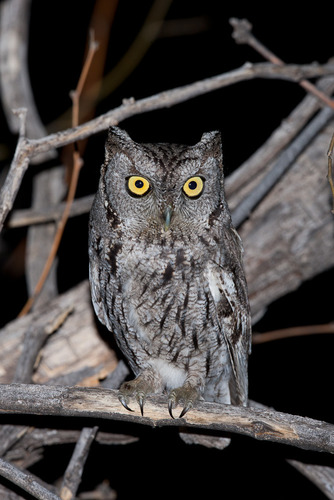
Western Screech-Owl
Megascops kennicottii
A pint-sized predator with a haunting song, the Western Screech-Owl is the ultimate backyard ghost, perfectly camouflaged against the trees of suburban North America.
Quick Identification
Size
Length: 19–25 cm (7.5–10 in); Wingspan: 55 cm (22 in); Weight: 100–240 g (3.5–8.5 oz)
Colors
Mottled grey or brownish plumage with intricate dark streaks; bright yellow eyes; bill is usually dark grey to black.
Key Features
- Small size with prominent 'ear' tufts
- Brilliant yellow eyes
- Bark-like camouflage with heavy vertical streaking
- Greyish-black bill
When You’ll See Them
Behavior
The Western Screech-Owl is a master of disguise, spending its daylight hours pressed against tree trunks where its plumage blends perfectly with the bark. While they are fierce hunters, they are relatively small and must stay hidden from larger predators like Great Horned Owls. They are strictly nocturnal, becoming active shortly after sunset to hunt for a wide variety of prey using their exceptional hearing and low-light vision.
These owls are remarkably well-adapted to human presence and are common residents in suburban backyards that provide mature trees or nesting boxes. They are monogamous and often stay with the same mate for life, frequently returning to the same nesting site year after year. Their presence is most often announced by their distinctive 'bouncing ball' song—a series of short whistles that accelerate at the end—rather than a typical 'hoot'.
EverydayEarth exclusive
Camera Tips
To capture the Western Screech-Owl on camera, the most effective strategy is to focus on a nesting box or a known roosting cavity. Mount your camera on a nearby branch or post about 5 to 10 feet away from the entrance, ensuring it is at the same height as the hole (typically 10–20 feet off the ground). Because these owls are strictly nocturnal, your camera’s infrared (IR) capabilities are vital. Set your camera to take short video clips (15–30 seconds) rather than just stills, as this allows you to observe their fascinating 'bobbing' head movements and vocalizations.
If you don't have a nesting box, water is a powerful secondary attractant. Western Screech-Owls are frequent visitors to backyard birdbaths for drinking and bathing, especially during dry summer months. Place the camera low, about 2–3 feet from the water source, angled slightly upward. Ensure your AI-powered camera is set to its highest sensitivity for night movement, as their silent flight can sometimes fail to trigger sluggish sensors.
Since these birds have incredibly sensitive hearing, choose a camera with a silent shutter to avoid scaring them away. During the spring breeding season (March–May), they are much more active and vocal. If your camera supports sound-triggered recording, this is the best time to capture their 'bouncing ball' trill. Avoid using white-light flashes at night, as this can temporarily blind the owl and disrupt its hunting; stick to 'No-Glow' IR LEDs for the best results without disturbing the wildlife.
Similar Species
Species that look similar or are commonly confused with Western Screech-Owl.
Eastern Screech-Owl
Nearly identical in appearance but features a pale yellowish bill and a 'whinny' call rather than a 'bouncing ball' trill.
Flammulated Owl
Much smaller with dark brown eyes rather than yellow, and lacks the prominent ear tufts of the Screech-Owl.
Whiskered Screech-Owl
Found in the desert Southwest; has smaller feet and a different vocalization consisting of telegraph-like 'boop' sounds.
Frequently Asked Questions
Record Western Screech-Owl at your habitat
Connect a camera to start building your own species record — AI identifies every visitor automatically.