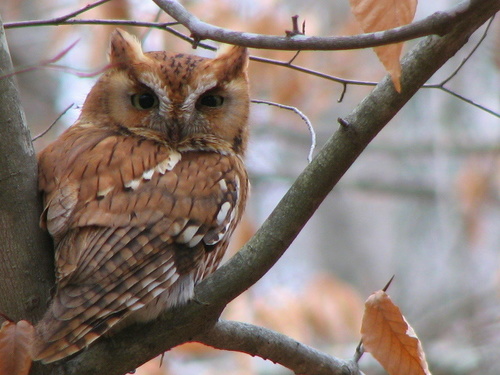
Eastern Screech-Owl
Megascops asio
The ultimate backyard ghost, the Eastern Screech-Owl blends perfectly into the bark of your favorite oak tree. Small in stature but big in personality, this nocturnal neighbor is a master hunter of the night.
Quick Identification
Size
Length: 16–25 cm (6.3–10 in) | Wingspan: 48–61 cm (19–24 in) | Weight: 120–245 g (4.2–8.6 oz)
Colors
Occurs in two distinct color morphs: gray and rufous (reddish-brown). Both feature complex banding and spotting that mimics tree bark. Eyes are bright yellow; bill is pale greenish-gray.
Key Features
- Prominent feathered ear tufts (often held flat)
- Stocky silhouette with a large head and almost no neck
- Intricate, bark-like camouflage pattern
- Bright yellow irises and a yellowish-green beak
When You’ll See Them
Sightings on EverydayEarth
Feb 23, 2026
An Eastern Screech-Owl is captured exiting the nest box. It moves from the substrate at the bottom of the frame toward the top opening and has completely departed the box by the two-second mark.
Feb 13, 2026
At dusk, an Eastern Screech Owl was observed roosting nearly motionless at the entrance of a wooden nest box amidst a snowy landscape. The owl remained largely stationary with its eyes partially closed, occasionally shifting its head to monitor the environment as it prepared for its nocturnal hunting period.
Geographic range
Where Does the Eastern Screech-Owl Live?
The Eastern Screech-Owl is native to the North American continent, maintaining a robust presence across the eastern half of the region. Its territory extends from the rocky woods of south-central Canada down through the United States to the subtropical forests of northeastern Mexico. While they are most concentrated in the Eastern U.S., they successfully inhabit environments ranging from rural farmsteads to densely populated suburban neighborhoods, staying within their home territories as year-round residents.
Basemap © OpenStreetMap contributors
Recorded on EverydayEarth
Behavior
The Eastern Screech-Owl is a master of disguise, spending its daylight hours tucked into tree cavities or pressed tightly against a trunk, where its mottled plumage makes it nearly invisible. Despite being common in suburban areas, it is strictly nocturnal and rarely seen unless flushed from a roost. They are famous for their vocalizations, which are not actually screeches, but rather mournful whinnies and tremulous trills that can be heard echoing through neighborhoods at night.
These owls are solitary for much of the year but form monogamous pairs during the breeding season. They are 'sit-and-wait' predators, perched on low branches and scanning the ground for movement. While they are generally tolerant of human activity, they are fiercely defensive of their nest sites and have been known to dive-bomb intruders—including humans—who get too close to their young.
EverydayEarth exclusive
Camera Tips
To capture high-quality footage of an Eastern Screech-Owl, the most effective strategy is to focus your camera on a nesting box. These owls are frequent users of man-made boxes, especially during the late winter and spring. Mount your camera on a nearby branch or a separate pole about 5–10 feet away, angled slightly downward toward the entrance hole. Since screech-owls often sit in the entrance hole at dusk to observe the world before hunting, this placement offers the best chance for a clear 'portrait' shot.
If you don't have a nest box, look for 'whitewash' (fecal splatters) or pellets at the base of mature trees with hollows. Place your camera 3–5 feet off the ground on a tripod or strap it to a neighboring tree, focusing on a low, horizontal branch that looks like a likely hunting perch. Because these birds are strictly nocturnal, ensure your camera has high-quality infrared (no-glow) LEDs to avoid spooking the bird or creating 'white-out' images on their highly reflective feathers.
Set your camera to 'Hybrid Mode' (photo followed by video) with a high PIR sensitivity. Screech-owls move quickly when diving for prey, so a fast trigger speed is essential. In the winter, you might also find them near heated birdbaths, as they need to drink and bathe even in cold weather. Capturing a screech-owl mid-bath is a rare and rewarding sight for any backyard observer.
Similar Species
Species that look similar or are commonly confused with Eastern Screech-Owl.
Western Screech-Owl
Nearly identical in appearance, but has a darker bill and a distinct 'bouncing ball' song instead of a whinnny.
Great Horned Owl
Much larger (3-4 times the size) with a deep, classic hooting call and much heavier talons.
American Kestrel
Similar size and often uses the same nesting boxes, but is a colorful, diurnal (day-active) falcon with pointed wings.
Frequently Asked Questions
Record Eastern Screech-Owl at your habitat
Connect a camera to start building your own species record — AI identifies every visitor automatically.