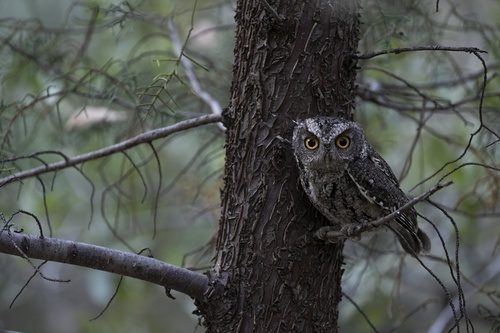
Whiskered Screech-Owl
Megascops trichopsis
A tiny master of disguise with a voice like Morse code, the Whiskered Screech-Owl is a hidden gem of the Southwestern mountains. Discover how to spot this elusive nocturnal hunter right in your own backyard.
Quick Identification
Size
Length: 17-20 cm (6.5-8 in); Wingspan: 43-50 cm (17-20 in); Weight: 70-121 g (2.5-4.3 oz)
Colors
Mottled grey or rufous-brown plumage; facial disk outlined in black; bright yellow eyes; greenish-grey bill; heavy horizontal black barring on underparts.
Key Features
- Long, whisker-like facial bristles
- Horizontal barring on breast and belly
- Small feet and dainty build
- Distinctive 'telegraph' or syncopated call
When You’ll See Them
Behavior
The Whiskered Screech-Owl is a secretive, nocturnal hunter that spends its days hidden in dense foliage or tree cavities. Unlike its more suburban-friendly cousins, this owl prefers the rugged oak-pine woodlands of the Southwest. They are highly territorial and use a distinct, telegraph-like hooting pattern to mark their domain and communicate with mates during the breeding season.
In social interactions, they are monogamous and often return to the same nesting site year after year. While they aren't naturally aggressive toward humans, they are master camouflagers; if they feel threatened, they will stretch their bodies and lean to mimic a broken branch, staying perfectly still until the danger passes.
EverydayEarth exclusive
Camera Tips
To capture the Whiskered Screech-Owl, focus your efforts on oak or sycamore trees with existing woodpecker cavities. Place your camera about 5 to 8 feet off the ground, angled slightly upward toward a known nesting hole or a flat, horizontal branch used as a hunting perch. Because these owls are small, a 'macro' or close-focus setting on your trail camera is ideal to prevent blurry images. Since they are strictly nocturnal, ensure your camera has a high-quality 'no-glow' or 'low-glow' infrared flash to avoid startling the bird or washing out the fine details of their plumage.
While we don't recommend using live bait, you can attract them by creating a bug-friendly environment. A small, solar-powered 'bug light' placed near a branch within the camera's field of view can act as a natural lure, drawing in the moths and beetles that the owl hunts. If you're setting up in a backyard near a forest edge, a shallow, elevated birdbath with a solar dripper can also be a magnet for these owls, as they need to drink and bathe even in the dry mountain air.
Timing is crucial. Set your trigger sensitivity to high, as these owls move with incredible speed and silence. The best time to catch them on camera is during the late spring and early summer when they are feeding hungry chicks. During this period, the adults will make frequent trips back and forth to the nest. If your camera supports video mode with audio, enable it; the Whiskered Screech-Owl's 'syncopated' call is one of the best ways to confirm the species identification, as it sounds remarkably like a Morse code signal.
Similar Species
Species that look similar or are commonly confused with Whiskered Screech-Owl.
Western Screech-Owl
Larger feet and more vertical streaking on the breast; lacks the long facial bristles.
Eastern Screech-Owl
Found in more eastern ranges; has a descending whinny call and more vertical belly patterns.
Flammulated Owl
Smaller with dark eyes instead of yellow; typically found at even higher elevations.
Frequently Asked Questions
Record Whiskered Screech-Owl at your habitat
Connect a camera to start building your own species record — AI identifies every visitor automatically.