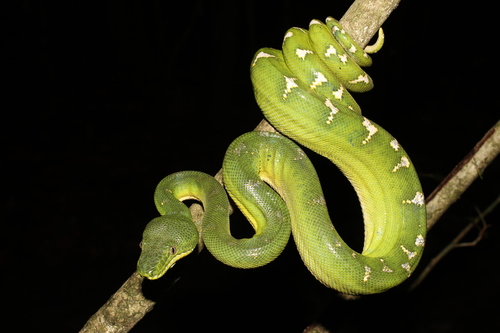
Emerald Tree Boa
Corallus caninus
With its brilliant green scales and iconic coiled pose, the Emerald Tree Boa is the crown jewel of the South American canopy. This master of disguise is a nonvenomous marvel of evolution, perfectly adapted for life high above the jungle floor.
Quick Identification
Size
Adults typically reach 1.5 to 2 meters (5 to 6.5 feet) in length; weighing between 0.9 to 2.2 kg (2 to 5 lbs).
Colors
Adults are a brilliant emerald green with white 'lightning bolt' or zig-zag dorsal markings; juveniles vary from brick-red to bright orange.
Key Features
- Vivid green scales with white dorsal zig-zag patterns
- Highly prehensile tail used for anchoring to branches
- Large, thermoreceptive heat pits along the upper lip
- Massive front teeth for penetrating thick feathers or fur
When You’ll See Them
Geographic range
Where Does the Emerald Tree Boa Live?
The Emerald Tree Boa is native to the lush, humid tropical rainforests of South America. Its core range is centered within the Guiana Shield, encompassing the countries of Guyana, Suriname, and French Guiana, as well as parts of northern Brazil and southern Venezuela. While they are strictly a New World species, they are often confused with pythons from other continents due to their remarkably similar appearance and lifestyle.
Basemap © OpenStreetMap contributors
Behavior
The Emerald Tree Boa is a quintessential arboreal specialist, spending nearly its entire life suspended in the rainforest canopy. These snakes are famous for their unique resting posture, where they drape their body in neat coils over a horizontal branch with their head resting right in the center. While they appear sedentary during the day, they are highly effective ambush predators that become active under the cover of darkness.
Despite their somewhat intimidating appearance and large teeth, they are nonvenomous and generally solitary. In the wild, they rarely interact with humans, preferring the seclusion of high branches. However, they are known for their patience; a single boa may remain in the exact same hunting position for several days, waiting for the perfect moment to strike at a passing mammal or bird.
EverydayEarth exclusive
Camera Tips
To capture an Emerald Tree Boa on camera, you must think vertically. These snakes rarely touch the ground, so placing a camera at eye level will likely yield nothing but forest floor. Instead, mount your AI-powered camera 2 to 5 meters (6 to 16 feet) high, focusing on horizontal branches or 'bridges' of vines that connect dense patches of canopy. These are the natural highways and hunting platforms for the species.
Because they are nocturnal, ensure your camera has high-quality infrared (IR) night vision. Emerald Tree Boas are ambush predators that stay motionless for long periods, which can sometimes fail to trigger standard PIR motion sensors. If your camera supports time-lapse mode or has a highly sensitive trigger, use those settings. Look for 'hotspots' near water sources or fruiting trees that attract the small rodents and birds the boa preys upon.
Lighting is another crucial factor; the emerald green of their scales is spectacular but can appear washed out by intense IR flashes. If possible, use a camera with 'No-Glow' IR to avoid startling the animal or attracting insects that might obscure the lens. Since they may remain in the same spot for days, a camera with a large SD card and long battery life is essential to capture the slow-motion drama of their hunting behavior.
Similar Species
Species that look similar or are commonly confused with Emerald Tree Boa.
Frequently Asked Questions
Record Emerald Tree Boa at your habitat
Connect a camera to start building your own species record — AI identifies every visitor automatically.