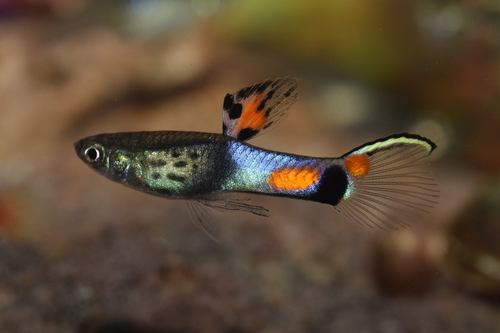
Endler's Livebearer
Poecilia wingei
A living jewel of the Venezuelan lagoons, the Endler's Livebearer is a tiny marvel of evolution, boasting neon colors that look almost artificial in their intensity.
Quick Identification
Size
Males range from 0.8 to 1.2 inches (2–3 cm); females are larger, reaching up to 1.8 inches (4.5 cm).
Colors
Males display metallic neon patches of orange, emerald green, and sky blue with black spots; females are a plain, translucent tan or silver.
Key Features
- Intense metallic neon color patches in males
- Small, slender body with a sleek profile
- Distinctive black 'comma' or side-spot markings
- Significant size difference between colorful males and larger, drab females
When You’ll See Them
Geographic range
Where Does the Endler's Livebearer Live?
The Endler's Livebearer is native to a very specific and tiny corner of the world in northeastern Venezuela. These brilliant fish are endemic to the Paria Peninsula, with their most famous wild populations historically found in the Laguna de Patos and the surrounding drainage systems near the city of Cumaná. While their wild range is geographically restricted and threatened by local development, they have become globally widespread through the aquarium trade and are now maintained in managed backyard ponds and tanks across every continent except Antarctica.
Basemap © OpenStreetMap contributors
Behavior
Endler's Livebearers are remarkably energetic and social fish that stay in constant motion. In their natural habitat, they are top-to-mid-water dwellers, frequently darting through aquatic vegetation to forage for food or escape the gaze of predators. They exhibit complex social behaviors, with males spending a significant portion of their daylight hours performing elaborate courtship displays to attract females, involving rapid fin-flicking and zig-zag swimming patterns.
Unlike many other fish species, Endlers are highly inquisitive and less skittish around larger movements, which has made them a favorite for observation. They are 'livebearers,' meaning they do not lay eggs but instead give birth to fully developed, free-swimming fry. This leads to a very active population dynamic where multiple generations often coexist in the same small body of water, creating a bustling, multi-layered social community.
EverydayEarth exclusive
Camera Tips
To capture the stunning neon colors of Endler's Livebearers with an AI-powered camera, you should focus on an underwater or 'pond-side' setup. If you are monitoring them in a backyard pond, position your camera at a 45-degree angle to the water's surface to minimize glare, or better yet, use a waterproof housing to submerge the lens just below the surface. Place the camera near a cluster of floating plants like Duckweed or Frogbit, as the fish naturally congregate there to hunt for mosquito larvae and seek shelter from the sun.
Lighting is the most important factor for this species; their metallic scales only truly 'shimmer' when hit by direct, bright light. The best footage is usually captured during the peak sun hours of mid-morning to early afternoon. If your camera setup allows for it, use a high shutter speed or a 60fps video setting, as these fish move with incredible speed and can easily appear as a blurry streak of color on standard settings. Avoid using infrared night vision, as it will not capture their primary appeal—their vibrant colors.
Using a lure is highly effective for gathering the colony in front of the lens. A small amount of floating flake food or a mesh bag of live brine shrimp will create a 'feeding frenzy' that brings both the drab females and the spectacular males into the frame. For the most professional look, try to position the camera so the background consists of dark green aquatic plants; this creates a high-contrast backdrop that makes the neon oranges and greens of the males stand out vividly for the AI detection software.
Similar Species
Species that look similar or are commonly confused with Endler's Livebearer.
Frequently Asked Questions
Record Endler's Livebearer at your habitat
Connect a camera to start building your own species record — AI identifies every visitor automatically.