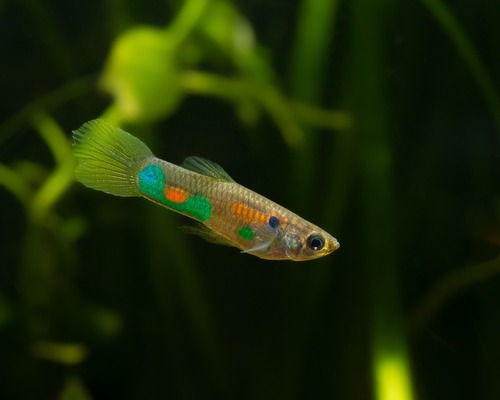
Guppy
Poecilia reticulata
The guppy is nature's most resilient 'rainbow fish,' a tiny powerhouse of color and activity that has conquered tropical waters worldwide. Whether in a jungle stream or a backyard pond, these social livebearers are a joy to observe and photograph.
Quick Identification
Size
Males range from 1.5–3.5 cm (0.6–1.4 in); females are larger at 3–6 cm (1.2–2.4 in)
Colors
Males are highly polymorphic with vibrant spots and stripes in neon orange, blue, and green; females are typically a muted olive or silver-grey
Key Features
- Elongated, colorful caudal fins in males
- Dull silver bodies with a 'gravid spot' near the anal fin in females
- Small, upturned mouths adapted for surface feeding
- Males possess a gonopodium for internal fertilization
When You’ll See Them
Geographic range
Where Does the Guppy Live?
Native to the freshwater streams and coastal waters of Northeast South America, the guppy's ancestral home spans across Venezuela, Guyana, Suriname, and northern Brazil, as well as several Caribbean islands like Trinidad and Tobago. However, due to their popularity in the aquarium trade and their use in mosquito-borne disease prevention, they have been introduced to nearly every continent except Antarctica. Today, you can find established wild populations in the warm waters of the southern United States, Southeast Asia, and parts of Australia.
Basemap © OpenStreetMap contributors
Behavior
Guppies are exceptionally social and energetic fish, known for their constant movement and shoaling behavior. In the wild, they form groups to better detect predators and forage for food. They are famous for their high reproductive rate, which has earned them the nickname 'millionfish.' Unlike many other fish that lay eggs, guppies are livebearers, meaning the females give birth to fully formed, free-swimming fry.
These fish exhibit complex social hierarchies and mating displays. Males spend a significant portion of their day performing 'sigmoid displays'—vibrating their bodies in an S-shape to attract females. While they are generally peaceful, they are opportunistic feeders and are often used by humans for mosquito control because they voraciously consume aquatic insect larvae.
EverydayEarth exclusive
Camera Tips
Capturing the vibrant flash of a wild or pond-dwelling guppy requires a specialized approach since these subjects are small and underwater. For the best results, use an action camera with a dedicated macro lens or a waterproof trail camera capable of focusing at close range. Submerge the camera at the edge of the pond or stream, roughly 2-4 inches below the surface, and angle it slightly upward toward the light. This positioning captures the best reflections off the male's iridescent scales.
Lighting is your greatest ally and your biggest challenge. In an outdoor backyard pond, wait for a day with bright, diffused sunlight. Direct, midday sun can create harsh glares on the water's surface that confuse the camera's sensor. If your pond is shaded, consider using a small, waterproof LED light positioned at a 45-degree angle from the camera to illuminate the fish without causing 'backscatter' (reflections off floating particles).
To draw the guppies into your camera's focus zone, use a small amount of bait. A tiny pinch of crushed fish flakes or a few drops of liquid infusoria will cause a feeding frenzy, bringing the whole shoal into the frame. Set your camera to a high frame rate—at least 60 frames per second—as these fish move incredibly fast. This allows you to pull high-quality still frames from the video where the guppy is perfectly side-on, showcasing its colorful fins.
Finally, patience is key. Guppies are curious but can be startled by sudden movements or the initial placement of a large object like a camera housing. Leave the equipment in the water for at least 15 minutes before you expect natural behavior to resume. If you are using a trail camera with a trigger, ensure the 'motion sensitivity' is set to the highest level, as the small size of the guppy might not always trigger standard sensors.
Similar Species
Species that look similar or are commonly confused with Guppy.
Frequently Asked Questions
Record Guppy at your habitat
Connect a camera to start building your own species record — AI identifies every visitor automatically.