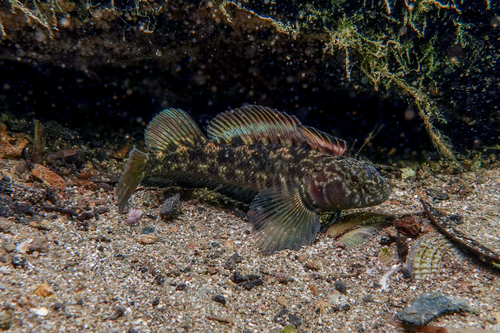
Estuarine Triplefin
Forsterygion nigripenne
A resilient native of New Zealand's coastlines, the Estuarine Triplefin is a master of the intertidal zone. Known for its 'three-finned' silhouette and bold personality, it is a staple of backyard estuaries and rock pools.
Quick Identification
Size
Typically 8 to 15 cm (3 to 6 inches) in length.
Colors
Mottled olive, brown, or grey with dark vertical bands; breeding males turn nearly jet black with blue-edged fins.
Key Features
- Three distinct dorsal fins
- Pointed snout with large, high-set eyes
- Dark vertical bars or blotches on the body
- Rests on the bottom using large pectoral fins
When You’ll See Them
Geographic range
Where Does the Estuarine Triplefin Live?
The Estuarine Triplefin is a native specialist of the Southwest Pacific, found exclusively across the coastline of New Zealand. Its range spans the entirety of the North and South Islands, as well as Stewart Island and the Chatham Islands. Because it is highly tolerant of varying salinity levels, it is one of the few triplefin species that can be found several kilometers inland in lowland river systems and brackish lagoons.
Basemap © OpenStreetMap contributors
Behavior
The Estuarine Triplefin, commonly known in New Zealand as a 'cockabully,' is a territorial and bottom-dwelling fish. It is most frequently observed 'perching' on rocks or the sandy substrate of estuaries using its large, fan-like pectoral fins. It moves in short, rapid darts rather than sustained swimming, a behavior that helps it stay close to cover while hunting or defending its patch of the seabed.
These fish are remarkably bold and curious, often showing little fear of humans or larger creatures. During the breeding season, which typically occurs in late winter and spring, the males undergo a dramatic color change to black and become highly protective of their nesting sites. They will aggressively chase away rivals and even larger fish to protect the eggs laid by females under rocks or within crevices.
EverydayEarth exclusive
Camera Tips
To capture the Estuarine Triplefin on camera, you will need a waterproof action camera or a specialized underwater housing. Because these fish live in the intertidal zone, the best approach is to mount your camera on a heavy, low-profile weighted base or a small underwater tripod. Position the lens just a few inches from a prominent flat rock or the entrance to a small crevice, as these are the preferred 'perching' spots where triplefins wait for prey.
Clarity is your biggest challenge in estuarine environments. Aim to film during a rising tide on a calm day; the incoming ocean water is usually much clearer than the receding tide, which carries silt from upstream. Natural lighting is best between mid-morning and mid-afternoon when the sun is directly overhead, penetrating the shallow water to reveal the fish's intricate mottled patterns. If your camera has a 'macro' mode or a close-focus lens, use it, as these fish are small and detail-oriented.
While you don't necessarily need bait, you can encourage activity by gently turning over a small rock near the camera to expose tiny invertebrates, or by placing a crushed green-lipped mussel just inside the frame. The scent will quickly draw in any nearby triplefins. During the spring, keep an eye out for the striking jet-black males; they are much more stationary as they guard their nests, making them excellent subjects for longer, stable video clips.
Similar Species
Species that look similar or are commonly confused with Estuarine Triplefin.
Frequently Asked Questions
Record Estuarine Triplefin at your habitat
Connect a camera to start building your own species record — AI identifies every visitor automatically.