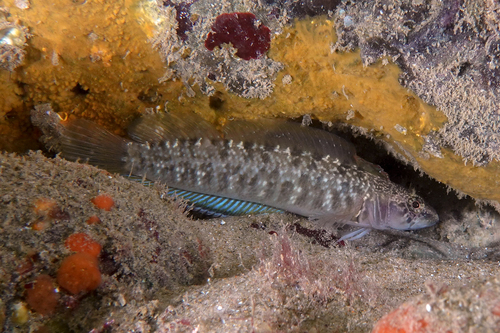
Longfinned Triplefin
Ruanoho decemdigitatus
An endemic treasure of the New Zealand coast, the Longfinned Triplefin is a master of camouflage that 'hops' across the seafloor with remarkable personality.
Quick Identification
Size
Up to 12 cm (4.7 inches) in total length
Colors
Mottled grey, olive, and brown with dark vertical bars; breeding males turn jet black with iridescent blue fin edges
Key Features
- Three distinct dorsal fins (characteristic of triplefins)
- Ten rays in the first dorsal fin
- Elongated filaments on the dorsal spine of males
- Large, fan-shaped pectoral fins used for perching
When You’ll See Them
Geographic range
Where Does the Longfinned Triplefin Live?
The Longfinned Triplefin is a proud endemic species of New Zealand, found nowhere else on Earth. It inhabits coastal waters around both the North and South Islands, as well as Stewart Island. While it can be found in many marine environments, it specifically prefers semi-sheltered areas where silty substrates meet rocky reefs, rather than the high-energy, wave-pounded outer coastlines.
Basemap © OpenStreetMap contributors
Behavior
The Longfinned Triplefin is a quintessential bottom-dweller, spending its life perched atop rocks and cobbles in the shallow reefs of New Zealand. Unlike many fish that cruise through open water, this species moves in a series of short, sharp 'hops,' using its powerful pectoral fins to launch itself from one vantage point to the next. They are highly territorial, and a single male will often guard a specific rock or crevice with surprising tenacity for his size.
During the breeding season, the social behavior of these fish becomes even more pronounced. The males undergo a dramatic physical transformation, shedding their camouflaged mottled patterns for a striking, deep black coloration to signal their dominance. They perform elaborate displays with their long dorsal fins to attract females and ward off competing males, making them one of the most active and visible small fish in the New Zealand intertidal zone.
EverydayEarth exclusive
Camera Tips
To capture the Longfinned Triplefin on camera, you will need a waterproof action camera or a specialized underwater trail cam. The key is to mount the camera as close to the seafloor as possible. Use a weighted base or a low-profile tripod to keep the camera steady against the surge, and point the lens at a flat 'sentinel rock' where a triplefin is likely to perch and survey its territory.
Focus on 'edge' habitats—areas where a rocky reef transitions into a silty or sandy patch. These are the preferred hunting grounds for the Longfinned Triplefin. If you are setting up in a tide pool, wait for a calm day with high water clarity to avoid the 'snow' effect of suspended silt, which can trigger motion sensors unnecessarily and obscure the fish's intricate markings.
Since these fish move with sudden, lightning-fast 'hops,' set your camera to a high frame rate, ideally 60fps or higher. This will allow you to capture clear, freeze-frame images of their movement without motion blur. During the summer months, look for the jet-black breeding males; their high-contrast coloration makes them much easier for AI software to detect against the brown and green backdrop of the reef.
Similar Species
Species that look similar or are commonly confused with Longfinned Triplefin.
Frequently Asked Questions
Record Longfinned Triplefin at your habitat
Connect a camera to start building your own species record — AI identifies every visitor automatically.