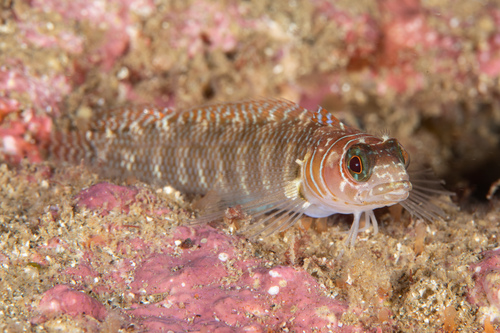
Spectacled Triplefin
Ruanoho whero
Meet the tiny sentinel of New Zealand's rocky reefs. With its distinctive blue-lined face and 'spectacled' eyes, the Spectacled Triplefin is a master of camouflage and a favorite for underwater observers.
Quick Identification
Size
4 to 8 cm (1.5 to 3.1 inches) in length
Colors
Mottled reddish-brown or greyish body; distinctive dark horizontal band across the eyes; fine electric blue lines on the head and fins.
Key Features
- Dark 'spectacle' band through eyes
- Fine electric blue lines on head and fins
- Large pectoral fins used for propping up on rocks
- Three distinct dorsal fins
When You’ll See Them
Geographic range
Where Does the Spectacled Triplefin Live?
Native to the Oceania region, the Spectacled Triplefin is an endemic species found exclusively around the coastline of New Zealand. It is widespread throughout the coastal waters of both the North and South Islands, as well as Stewart Island and the Chatham Islands. Thriving in the temperate waters of the South Pacific, this species is a staple of New Zealand’s near-shore marine ecosystems.
Basemap © OpenStreetMap contributors
Behavior
The Spectacled Triplefin is a bottom-dwelling specialist, spending the vast majority of its time perched on rocky substrates using its oversized pectoral fins like stilts. They are highly territorial, especially males during the breeding season, and can often be seen darting quickly between crevices if they feel threatened. Despite their small size, they are remarkably bold and will often watch underwater cameras or divers with curious, independent rotating eyes.
Socially, they are mostly solitary but can be found in high densities where the reef structure is complex and provides ample hiding spots. They rely on their excellent camouflage to blend into the encrusting life on the rocks, only moving when prey comes within striking distance. Unlike many fish that swim continuously, their movement is characterized by short, hop-like bursts across the seabed followed by long periods of stillness.
EverydayEarth exclusive
Camera Tips
Capturing the Spectacled Triplefin requires an underwater camera setup, such as an AI-powered reef cam or a waterproof action camera mounted in a fixed position. Because these fish are small and spend their time on the bottom, the camera should be positioned as low as possible, ideally 5 to 10 centimeters above the seafloor, angled slightly downward toward a flat rock or a patch of broken reef where they are likely to perch and hunt.
While baiting isn't strictly necessary, placing a small amount of crushed shellfish or a specialized fish attractant directly in front of the lens can draw them into the frame for a close-up. Be sure to secure the camera firmly using a weighted base or a clamp; even slight surges in the water can shift a light camera, ruining the focus on such a small subject. These fish have fantastic camouflage, so using a camera with high resolution and macro capabilities will help highlight the intricate blue lines and the 'spectacle' markings around their eyes.
Lighting is the most important factor in underwater photography. In shallow New Zealand waters, natural light is often sufficient between 10 AM and 2 PM on clear days. However, if you are filming at the deeper end of their 30-meter range, an external light source or a red filter might be needed to bring out the reddish-brown hues that are often lost as water absorbs longer light wavelengths. Look for areas with 'broken rock' or rocky reef margins, as these are their preferred hunting grounds and offer the best chance for a sighting.
Similar Species
Species that look similar or are commonly confused with Spectacled Triplefin.
Frequently Asked Questions
Record Spectacled Triplefin at your habitat
Connect a camera to start building your own species record — AI identifies every visitor automatically.