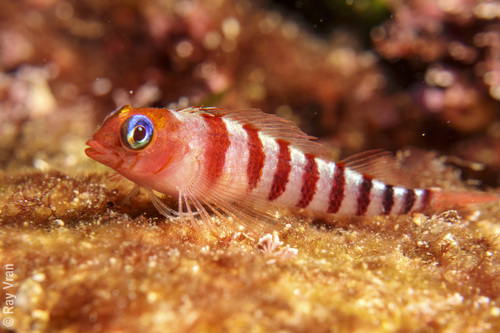
Blue-eyed Triplefin
Notoclinops segmentatus
A tiny jewel of the New Zealand reef, the Blue-eyed Triplefin captivates with its neon-blue gaze and vibrant crimson stripes. This hardy little fish is a master of the rocky shallows, perching on kelp and stone with unmatched charisma.
Quick Identification
Size
3 to 6 cm (1.2 to 2.4 inches) in length
Colors
Features a striking iridescent blue ring around the eye; the body is pale with nine bold red vertical bars; head and back often have an orange or yellowish hue.
Key Features
- Iridescent neon-blue eyes
- Nine vertical red bars encircling the body
- Three distinct dorsal fins characteristic of triplefins
- Small, slender profile under 6cm
- Orange-tinged snout and dorsal area
When You’ll See Them
Geographic range
Where Does the Blue-eyed Triplefin Live?
The Blue-eyed Triplefin is an endemic species native to the southwestern Pacific waters of New Zealand. Its primary range is concentrated around the coastal reefs of the North Island, though it is also found frequently around the Three Kings Islands to the north. While it is most abundant in the warmer northern waters, its presence extends through the Cook Strait to the northern coastline of the South Island.
Basemap © OpenStreetMap contributors
Behavior
The Blue-eyed Triplefin is a highly territorial and site-attached species, meaning it rarely ventures far from its chosen patch of reef. Unlike many fish that swim continuously in the water column, triplefins spend most of their time 'perched' on rocky surfaces or kelp fronds, using their large, fan-like pectoral fins as sturdy props. They are incredibly agile over short distances, moving in quick, darting hops to catch prey or retreat into a crevice when threatened.
These fish are generally solitary but can be found in loose aggregations where the habitat is particularly favorable. They exhibit curious behavior toward divers and underwater cameras, often watching observers with their swivel-mounted blue eyes. During the breeding season, males become more defensive of their territory, guarding eggs that have been laid on the rocky substrate by females.
EverydayEarth exclusive
Camera Tips
Capturing the Blue-eyed Triplefin requires an underwater housing or a dedicated waterproof 'drop camera' setup. For those with coastal 'backyards' or docks, the best placement is directly on a rocky ledge or near a crevice at a depth of 2 to 5 meters. Position the camera at a slight upward angle to capture the iridescent blue of the eyes against the ambient light filtering from the surface. Because these fish are small, a macro lens or a camera with a short minimum focus distance is essential for a clear shot.
Lighting is the most critical factor for this species. Without artificial light, the red bars on the body and the blue of the eyes will appear dull or grey due to water's natural light absorption. Use a high-CRI (Color Rendering Index) underwater video light or a diffused strobe to make the colors 'pop.' Avoid pointing the light directly at the fish; instead, use side-lighting to reveal the texture of the reef and the fish's unique triple-fin structure.
Since these fish are curious but easily spooked by sudden movement, use a tripod or a weighted beanbag to stabilize the camera on the seafloor. Set your camera to a high frame rate (at least 60fps) to catch their lightning-fast 'hopping' movements. If using a motion-trigger AI, ensure it is tuned for small subjects, as these fish often sit perfectly still for long periods before making a sudden dash. Leaving the camera in 'time-lapse' mode with 1-second intervals is a reliable fallback strategy for documenting their presence.
Similar Species
Species that look similar or are commonly confused with Blue-eyed Triplefin.
Frequently Asked Questions
Record Blue-eyed Triplefin at your habitat
Connect a camera to start building your own species record — AI identifies every visitor automatically.