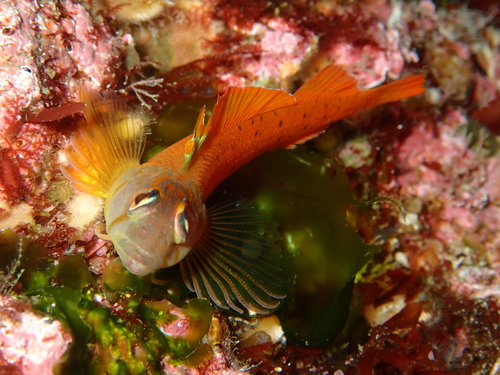
Yaldwyn's Triplefin
Notoclinops yaldwyni
A master of rocky camouflage, Yaldwyn's Triplefin is a vibrant yet elusive inhabitant of New Zealand's North Island reefs. This tiny fish is a treasure for underwater observers, recognized by its golden-hued head and delicate speckled patterns.
Quick Identification
Size
4-8 cm (1.5-3.1 inches) in length
Colors
Pale yellow-brown body with a faint orange-gold tinge on the head and horizontal rows of tiny black dots along the flanks.
Key Features
- Three distinct dorsal fins
- Pale yellow-brown body with orange-tinged head
- Two or three rows of small black dots on the sides
- Small, slender build reaching up to 8 cm
When You’ll See Them
Geographic range
Where Does the Yaldwyn's Triplefin Live?
Native to the southwestern Pacific Ocean, Yaldwyn's Triplefin is found exclusively around the coastal waters of the North Island of New Zealand. Its range is highly localized, focusing on temperate reef environments from the low-water mark down to shallow depths of about five metres. While it is widely distributed across the North Island's rocky shores, it is nowhere particularly common, making it a prized find for local marine enthusiasts.
Basemap © OpenStreetMap contributors
Behavior
Yaldwyn's Triplefin is a shy and cryptic reef dweller that spends its life close to the sea floor. Unlike many schooling fish, this species is solitary and highly territorial, often found 'perching' on rocky surfaces using its specialized pelvic fins. They are diurnal, meaning they are most active during daylight hours when they dart between crevices to find food or avoid larger predators like snapper or rock cod.
These fish exhibit a unique 'stop-and-go' swimming pattern. They remain perfectly still, blending into the speckled shadows of the reef, before making a lightning-fast lunge toward a passing crustacean. While they are not known to interact directly with humans, they are a favorite for snorkelers and underwater photographers who enjoy the challenge of spotting them against the broken rock backgrounds they prefer.
EverydayEarth exclusive
Camera Tips
To capture Yaldwyn's Triplefin on camera, you will need a specialized underwater setup or a high-quality action camera with an AI-triggering system. Because these fish live in very shallow water (0-5 metres), you can often set up your camera in large, deep rockpools during low tide. Look for areas described as 'broken rock'—the complex geometry of cracked stones and pebbles provides the cover this species requires to feel safe enough to emerge.
Mount your camera on a weighted tripod or a heavy sandbag to ensure it remains stationary against the surge of the tide. Position the lens as close to the rock surface as possible, as these fish are only a few inches long. If your camera supports it, use a macro lens or a close-focus setting. Angle the camera slightly upward to capture the distinct three-fin profile against the light, which helps highlight the orange tinge on the head and the black spots on the flanks.
Patience is key with this species. Yaldwyn's Triplefins are easily spooked by sudden movement, so leave your camera in place for at least an hour. Using a time-lapse mode—taking a photo every 5 seconds—is often more effective than motion-triggering, as the fish's small size and camouflaged skin might not always wake up an AI sensor. For the best results, film on a day with high water clarity and low swell to prevent 'backscatter' (floating debris) from ruining your shots.
Similar Species
Species that look similar or are commonly confused with Yaldwyn's Triplefin.
Frequently Asked Questions
Record Yaldwyn's Triplefin at your habitat
Connect a camera to start building your own species record — AI identifies every visitor automatically.