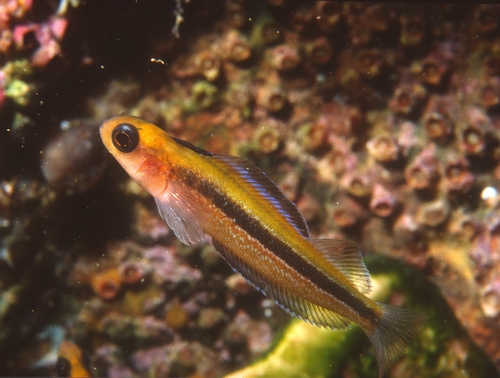
Oblique-swimming Triplefin
Forsterygion maryannae
New Zealand's vibrant reef socialite, the Oblique-swimming Triplefin, breaks all the rules of its family by schooling in mid-water with a unique, head-up tilt.
Quick Identification
Size
A small reef fish reaching 4–6 cm (1.6–2.4 inches) in length.
Colors
Bright yellow to reddish-orange body, often featuring a brilliant blue or silvery-white horizontal stripe running from the snout to the tail.
Key Features
- Distinctive 'head-up' oblique swimming posture
- Three separate dorsal fins characteristic of triplefins
- Vibrant yellow or orange coloration with lateral stripes
- Forms large, active schools above the seabed
When You’ll See Them
Geographic range
Where Does the Oblique-swimming Triplefin Live?
Native to the Oceania region, the Oblique-swimming Triplefin is found exclusively along the northeastern coast of New Zealand's North Island. Its core range extends from the Three Kings Islands in the north down to the Bay of Plenty, where it thrives in clear, temperate coastal waters. Because it is endemic to this specific stretch of coastline, it cannot be found naturally anywhere else in the world.
Basemap © OpenStreetMap contributors
Behavior
The Oblique-swimming Triplefin is a social outlier in the triplefin family. While most of its relatives are cryptic bottom-dwellers that spend their lives resting on rocks, this species is highly active and gregarious. They form loose, swirling schools that can number in the hundreds, hovering several meters above rocky reef structures to feed on passing nutrients.
These fish are also known to act as occasional 'cleaners.' They have been observed approaching larger reef fish, such as snapper or moki, to pick off small parasites. Their most famous trait is their swimming angle; they maintain a 30-to-45-degree upward tilt, which is thought to help them better spot tiny planktonic prey silhouetted against the light from the surface.
EverydayEarth exclusive
Camera Tips
To capture the Oblique-swimming Triplefin on an underwater camera, placement is everything. Look for rocky outcrops or the edges of kelp forests where the current is steady but not overwhelming. Using a weighted tripod or a secure suction mount on a flat rock surface is essential to keep the frame steady. Position the camera to look slightly upward; this allows you to capture their unique oblique swimming silhouette against the brighter surface water, which makes for a much more dramatic shot than looking down at the dark reef.
Because these fish are small and move in quick, darting bursts, use a high frame rate setting—at least 60fps—to ensure the motion remains fluid during playback. If you are filming at depths below 10 metres, the water will naturally filter out red and yellow light, making these vibrant fish look dull and grey. Use a red dive filter or a dedicated underwater video light to bring back their brilliant natural oranges and yellows.
These fish are naturally curious and often attracted to the movement of other fish. If you can find a 'cleaning station' where larger fish congregate to have parasites removed, set your camera nearby. The Oblique-swimming Triplefins will often drift into the frame to service the larger clients. Ensure your AI-powered camera is set to a wide-angle FOV (Field of View) to capture the mesmerizing patterns of the entire school rather than just a single individual.
Similar Species
Species that look similar or are commonly confused with Oblique-swimming Triplefin.
Frequently Asked Questions
Record Oblique-swimming Triplefin at your habitat
Connect a camera to start building your own species record — AI identifies every visitor automatically.