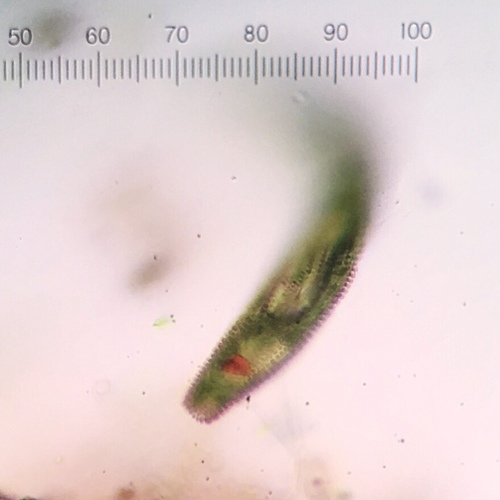
Euglena spirogyra
Lepocinclis spirogyroides
Step into the hidden world of the pond with Euglena spirogyra, a microscopic marvel featuring a stunning spiraled shell and a sun-seeking personality. This tiny architect of the water column proves that even the smallest life forms have incredible stories to tell.
Quick Identification
Size
150–250 micrometers (0.006–0.01 inches) in length; invisible to the naked eye without magnification.
Colors
Bright leaf-green chloroplasts, yellowish-brown paramylon granules, and a prominent reddish-orange eyespot (stigma).
Key Features
- Spirally arranged rows of small, bead-like warts on the outer pellicle
- Two large, link-shaped paramylon grains located near the center
- Bluntly pointed posterior 'tail' or cauda
- Relatively rigid body compared to other Euglena species
When You’ll See Them
Geographic range
Where Does the Euglena spirogyra Live?
This microscopic traveler is native to freshwater environments across every continent except Antarctica. It is a cosmopolitan species, meaning it can be found in almost any country where suitable aquatic habitats exist, from the garden ponds of North America and Europe to the tropical rice paddies of Southeast Asia and the wetlands of South America. Because it can survive harsh conditions by forming a protective cyst, it is easily transported across vast distances by wind or on the damp feathers of migratory birds, allowing it to colonize even the most isolated backyard water features.
Basemap © OpenStreetMap contributors
Behavior
Euglena spirogyra (also known as Lepocinclis spirogyroides) is a fascinating single-celled organism that exhibits a mix of plant-like and animal-like traits. Unlike many of its cousins, this species is relatively rigid due to its thickened, spiraled pellicle, which prevents the dramatic shape-shifting (metaboly) common in other euglenids. It moves through the water using a single whip-like flagellum, often rotating slowly as it glides, which allows its beautiful spiral texture to catch the light.
A defining behavior of this species is its phototaxis—the ability to move toward light. It uses a specialized light-sensitive organelle called a stigma, or eyespot, to detect the direction of the sun. By positioning itself in optimal light, it can maximize its photosynthetic energy production. While they are solitary cells, they are frequently found in high densities in nutrient-rich waters, forming part of the vibrant microscopic community that sustains aquatic ecosystems.
EverydayEarth exclusive
Camera Tips
Capturing Euglena spirogyra requires a departure from traditional trail cameras; instead, you will need a digital microscope camera or a smartphone equipped with a high-power macro lens attachment. To begin your search, collect a water sample from the edge of a stagnant pond or a long-standing birdbath. Look for water with a slight green tint or areas where organic debris has settled, as these organisms congregate where nutrients are plentiful.
To view them, place a single drop of your sample onto a glass slide and gently apply a coverslip to create a 'wet mount.' For the best visual results, use a microscope with 'darkfield' illumination if available; this technique makes the spiraled, warty texture of the pellicle glow against a dark background, highlighting the species' namesake features. If using standard brightfield lighting, try closing the condenser diaphragm slightly to increase contrast, which helps the transparent cell structure become more visible.
Because this species is phototactic, you can experiment with 'herding' them for your camera. If you shine a small LED light from one side of the slide, the Euglena will slowly migrate toward the light source, allowing you to capture group interactions and movement patterns. Recording video is highly recommended over still photos, as the slow, majestic rotation of the cell as it swims is the most reliable way to identify the spiral ridges that distinguish it from smoother Euglena species.
Similar Species
Species that look similar or are commonly confused with Euglena spirogyra.
Frequently Asked Questions
Record Euglena spirogyra at your habitat
Connect a camera to start building your own species record — AI identifies every visitor automatically.