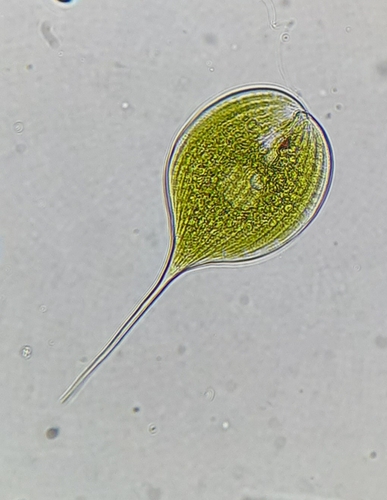
Phacus longicauda
Phacus longicauda
The 'leaf' of the microscopic world, Phacus longicauda is a stunning, vibrant green protist. With its elegant needle-like tail and graceful movement, it is a crown jewel of backyard pond life.
Quick Identification
Size
80–170 micrometers (μm) in length (approx. 0.003–0.006 inches)
Colors
Brilliant leaf-green body due to chloroplasts; features a small, bright red eyespot (stigma) at the anterior end.
Key Features
- Flattened, leaf-shaped rigid body
- Extremely long, straight, needle-like tail (cauda)
- Visible spiral striations or ridges across the surface
- Single whip-like flagellum for movement
When You’ll See Them
Behavior
Phacus longicauda is a remarkable single-celled flagellate that behaves like a hybrid between a plant and an animal. Unlike many of its microscopic relatives that are flexible and constantly change shape (a process called metaboly), Phacus possesses a very rigid outer layer known as a pellicle. This allows it to maintain its elegant, flattened, lentil-like shape as it glides through the water. It navigates its aquatic world using a single flagellum located at its front, which pulls the organism forward with a graceful, spinning motion.
As a photosynthetic organism, Phacus longicauda is highly sensitive to light. It uses a specialized red 'eyespot' to detect light direction and intensity, allowing it to swim toward the sunniest parts of a pond to maximize energy production. While they are usually solitary, they can be found in high concentrations in healthy, nutrient-rich backyard ponds, where they serve as a fundamental part of the food web, feeding tiny invertebrates like rotifers.
EverydayEarth exclusive
Camera Tips
Capturing Phacus longicauda requires a different approach than standard backyard wildlife. Instead of a trail camera, you will need a digital microscope or a high-quality smartphone microscope adapter capable of at least 100x to 400x magnification. To find them, collect a water sample from a still pond or a birdbath that has developed a slight green tint. The best samples are often found by gently squeezing aquatic moss or skimming the surface near floating plants where oxygen and light are plentiful.
For the best 'camera' results, use a concave glass slide to allow the organism room to move without being crushed. Because Phacus longicauda is relatively slow and maintains a rigid shape, it is an excellent subject for AI-powered micro-identification. Set your camera to a high frame rate (60fps or higher) to capture the rhythmic beating of its flagellum and the way it rotates as it swims. Adjust your microscope's iris diaphragm or use oblique lighting to highlight the beautiful spiral striations on its body surface, which can appear almost metallic under the right conditions.
If you are using an AI-powered smart microscope, ensure your lighting is consistent. The deep green color of Phacus longicauda provides excellent contrast against a bright-field background. Seasonal tip: look for 'blooms' during the hot summer months when water temperatures rise; a single drop of water during this time can contain dozens of these tiny, leaf-shaped wonders.
Similar Species
Species that look similar or are commonly confused with Phacus longicauda.
Frequently Asked Questions
Record Phacus longicauda at your habitat
Connect a camera to start building your own species record — AI identifies every visitor automatically.