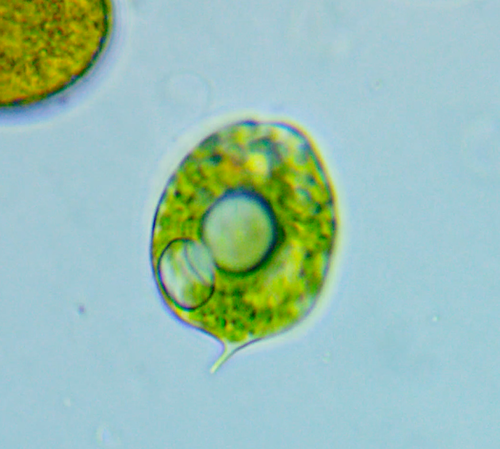
Phacus pleuronectes
Phacus pleuronectes
The leaf-shaped Phacus pleuronectes is a master of the microscopic world, turning sunlight into energy while gracefully spinning through pond water like a tiny emerald jewel.
Quick Identification
Size
30-50 micrometers (0.0011-0.0019 inches) in length; significantly smaller than a grain of salt.
Colors
Bright leaf-green body due to numerous disc-shaped chloroplasts; features a prominent ruby-red 'eyespot' (stigma) near the front.
Key Features
- Flat, leaf-like oval body that does not change shape
- Short, sharply curved posterior spine or 'tail'
- Fine longitudinal ridges or striae running down the pellicle
When You’ll See Them
Behavior
Phacus pleuronectes is a fascinating microscopic swimmer commonly found in the 'invisible forest' of backyard ponds and garden water features. Unlike its cousin, the Euglena, which can stretch and contract its body, Phacus pleuronectes possesses a rigid outer layer called a pellicle. This allows it to maintain a constant, flat, pancake-like shape as it glides through the water using a single, whip-like flagellum. It moves with a characteristic steady, rotating motion, almost like a spinning green plate.
These organisms are highly sensitive to light, exhibiting a behavior known as phototaxis. Using their red eyespot (stigma), they can detect the direction and intensity of light sources, swimming toward the sun to maximize their energy production through photosynthesis. While they are solitary, they can reach high densities in nutrient-rich water, turning the surface slightly green or 'soupy' during peak summer months.
EverydayEarth exclusive
Camera Tips
Capturing Phacus pleuronectes requires a departure from standard trail cameras; instead, you will need a digital microscope camera or a smartphone microscope attachment capable of at least 100x to 400x magnification. To start, collect a small sample of water from the surface of a backyard pond, specifically targeting areas where the water looks slightly green or near floating vegetation. Place a single drop on a glass slide, but do not use a coverslip immediately if you want to record their natural swimming rotation.
For the best visual results, use 'brightfield' lighting on your microscope. This involves shining the light from beneath the sample, which will make the emerald-green chloroplasts and the bright red eyespot of Phacus pleuronectes pop against the background. If your digital camera allows for high-frame-rate recording, use it; these micro-organisms move surprisingly fast, and a higher shutter speed will help prevent motion blur as they spin through the frame.
Timing is critical for these sun-loving microbes. If you are sampling a pond, do so in the early afternoon when they have migrated to the upper layers of the water column to feed on light. Avoid taking samples after heavy rain, as the dilution can make them harder to locate. To keep them in the field of view of your AI-powered microscope camera, you can add a tiny drop of 'ProtoSlow' or a similar thickening agent to the water to decrease their swimming speed without killing them.
When setting up your digital interface, focus on the 'pellicle' (the outer skin). If your resolution is high enough, the AI may be able to detect the fine longitudinal stripes that distinguish Phacus pleuronectes from other flat euglenoids. Keep your lens clean and ensure your lighting is consistent, as the AI’s ability to recognize the distinct leaf-shape depends heavily on clear silhouettes.
Similar Species
Species that look similar or are commonly confused with Phacus pleuronectes.
Frequently Asked Questions
Record Phacus pleuronectes at your habitat
Connect a camera to start building your own species record — AI identifies every visitor automatically.