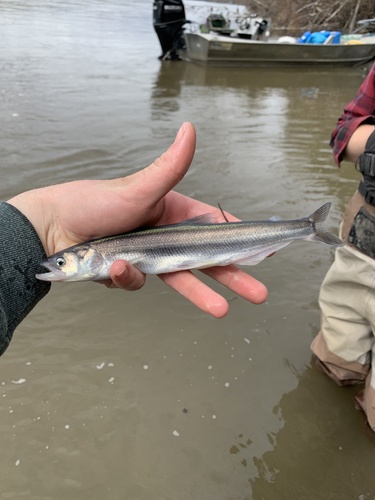
Eulachon
Thaleichthys pacificus
The eulachon is the shimmering 'candlefish' of the Pacific, a tiny but mighty smelt that fuels an entire coastal ecosystem during its legendary spring migration.
Quick Identification
Size
15 to 25 cm (6 to 10 inches) in length; 40 to 60 grams (1.4 to 2.1 ounces)
Colors
Iridescent blue-green or silver-blue on the back with shimmering silver sides and a white belly; translucent fins.
Key Features
- Distinct adipose fin near the tail
- Large pectoral fins reaching nearly to the pelvic fins
- Oily, translucent appearance
- Smells like fresh cucumbers when handled
When You’ll See Them
Geographic range
Where Does the Eulachon Live?
Native to the North American Pacific Coast, the eulachon is found in the cold, nutrient-rich waters of the Eastern Pacific Ocean. Its core range extends from the Pribilof Islands in the Bering Sea down through the coastal regions of Alaska and British Columbia, reaching its southern limit in Northern California. They are specifically tied to large river systems like the Columbia, Fraser, and Nass rivers for their annual migrations.
Basemap © OpenStreetMap contributors
Behavior
Eulachon, often called candlefish, are famous for their incredibly high lipid content, which can reach up to 15% of their total body weight. This oiliness is an evolutionary adaptation for their arduous anadromous journey, but it also made them a vital resource for Indigenous peoples, who dried the fish and used them as literal candles by threading a wick through their bodies. They spend most of their lives in the ocean and return to freshwater only to spawn.
During the spring, eulachon enter coastal rivers in massive, dense schools. This migration is a cornerstone event for the Pacific Northwest ecosystem, triggering a "feeding frenzy" that attracts thousands of bald eagles, seals, sea lions, and bears. They are highly social during this period, moving as a single shimmering mass to overwhelm predators through sheer numbers. Unlike salmon, they do not jump over obstacles and require relatively unobstructed river access.
EverydayEarth exclusive
Camera Tips
Capturing the eulachon run requires specialized underwater equipment, as these fish do not break the surface like salmon. An action camera with an underwater housing, such as a GoPro, is the best tool for the job. Mount the camera on a weighted tripod or a heavy stone and place it in shallow, slow-moving side channels of a river where the gravel is fine. This is where the fish congregate to deposit eggs, providing the most stable footage.
Visibility is the primary hurdle in river environments. Aim to set your camera during periods of low turbidity—usually after a few days without heavy rain. Position the camera so it faces across the current rather than directly into it to prevent debris from sticking to the lens. If you are filming during the day, ensure the sun is behind the camera to highlight the brilliant silver iridescence of the fish's scales; at night, use a dim, diffused light to capture spawning behavior without washing out the scene.
For those without underwater gear, a trail camera can still capture the secondary action of the run. Set your camera on a high bank overlooking shallow riffles or gravel bars. Look for "bio-indicators" like massive flocks of gulls or congregating eagles. Use high-speed video settings to record the predators diving into the water. This provides a dramatic narrative of the eulachon's role as a keystone species even if the fish themselves remain mostly submerged.
Similar Species
Species that look similar or are commonly confused with Eulachon.
Frequently Asked Questions
Record Eulachon at your habitat
Connect a camera to start building your own species record — AI identifies every visitor automatically.