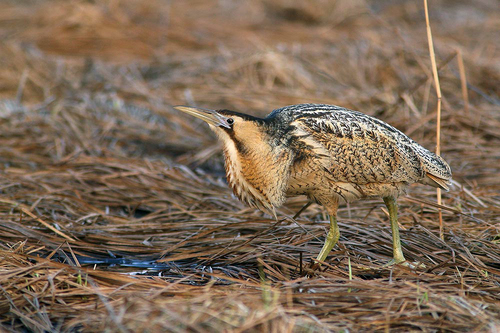
Eurasian Bittern
Botaurus stellaris
A master of camouflage hidden within the golden reeds, the Eurasian Bittern is a secretive marvel of the wetlands. Known for its deep, foghorn-like boom and incredible ability to vanish in plain sight, this elusive heron is a rare prize for any nature enthusiast.
Quick Identification
Size
Length: 69-81 cm (27-32 in), Wingspan: 100-130 cm (39-51 in), Weight: 900-1900g (2-4 lbs)
Colors
Mottled buff-brown, gold, and black plumage; dark crown and 'moustache' stripe; greenish-yellow legs.
Key Features
- Intricate buff-brown and black streaked plumage
- Long, thick yellowish-green legs and bill
- Broad wings with barred primary feathers
- 'Bitterning' posture with beak pointed skyward
When You’ll See Them
Geographic range
Where Does the Eurasian Bittern Live?
The Eurasian Bittern is native across a vast expanse of the Palearctic, stretching from the United Kingdom and Western Europe across Russia all the way to Japan. Its core breeding range includes the temperate regions of Eurasia, while significant populations also inhabit the northern and southern fringes of Africa. In the colder months, northern populations often migrate south to milder climates in the Mediterranean and South Asia to avoid frozen wetlands where hunting becomes impossible.
Basemap © OpenStreetMap contributors
Behavior
The Eurasian Bittern is a solitary and remarkably secretive heron that lives a ghost-like existence among dense reed beds. Rather than flying when threatened, it famously freezes, stretching its neck and beak vertically to mimic the surrounding vegetation—a behavior known as 'bitterning.' This camouflage is so effective that the bird can remain invisible even just a few feet away from observers.
During the spring breeding season, the males reveal their presence with a legendary 'booming' call. This low-frequency sound is produced by the male inflating its esophagus and can carry for up to 3 miles (5 km) across the marsh. While they are mostly shy around humans, they are formidable predators within their marshy territory, stalking prey with slow, deliberate movements before striking with lightning speed using their powerful dagger-like bills.
EverydayEarth exclusive
Camera Tips
Capturing a Eurasian Bittern on camera requires patience and strategic placement, as these birds are the ultimate wallflowers of the avian world. Because they spend the majority of their time within dense reed beds, your best bet is to position your AI-powered camera at the 'edge' of the vegetation where the reeds meet open water. Look for muddy margins, narrow channels, or small clearings in the reeds where they might emerge to hunt or move between feeding grounds.
Height and angle are critical for this species. Set your camera relatively low to the ground, about 30 to 50 centimeters high, and angle it slightly upward or parallel to the water's surface. This mimics their eye level and increases the chance of capturing their iconic 'bitterning' pose—where they stretch their neck and point their beak up to blend with the reeds. Ensure your PIR sensor sensitivity is adjusted; the constant swaying of reeds in the wind can lead to thousands of 'false' triggers, so try to point the camera at a clear spot in the foreground.
Unlike many garden birds, bitterns won't be lured by seeds or fat balls. They are attracted to habitat, not artificial bait. However, if you have a private pond or marshy area, maintaining a healthy population of small fish, rudd, or frogs is the natural 'lure' that will keep them coming back. Dawn and dusk are their peak activity times, so ensure your camera has high-quality infrared night vision or excellent low-light capabilities to catch them during these 'blue hours.'
In winter, when water starts to freeze, Bitterns become much easier to record. They will often congregate around the few remaining patches of ice-free water to hunt. If you notice a particular spot in your local wetland that stays liquid during a cold snap, that is the goldmine for camera placement. Just remember to use a camouflage wrap on your camera to help it blend into the dead, brown winter reeds, as their eyesight is incredibly sharp.
Similar Species
Species that look similar or are commonly confused with Eurasian Bittern.
Little Bittern
Much smaller in size with more distinct, flat blocks of color on the wings rather than the Eurasian's intricate mottling.
Grey Heron
Lacks the brown/buff camouflage; the Grey Heron is taller, grey-blue in color, and much more likely to be seen standing in open water.
American Bittern
Found in North America; nearly identical but has a distinct black neck patch and slightly finer streaking.
Frequently Asked Questions
Record Eurasian Bittern at your habitat
Connect a camera to start building your own species record — AI identifies every visitor automatically.