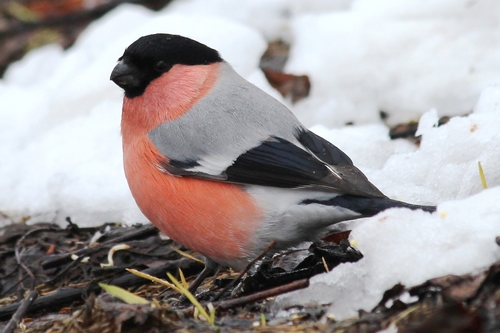
Eurasian Bullfinch
Pyrrhula pyrrhula
Admired for its vibrant rose-red breast and distinctive jet-black cap, the Eurasian Bullfinch is a crown jewel of the woodland edge. This shy, stocky finch is a master of the 'hide and seek' game, often revealing itself only through a soft, piping whistle from deep within a thicket.
Quick Identification
Size
Length: 14.5–16.5 cm (5.7–6.5 in); Wingspan: 22–29 cm (8.7–11.4 in); Weight: 21–38 g (0.7–1.3 oz)
Colors
Males have a bright rose-red breast and cheeks with a blue-grey back. Females are more subdued with pinkish-brown or beige-grey underparts. Both sexes share a black cap, black wings with a white wing bar, and a distinctive white rump.
Key Features
- Velvety black cap and chin contrasting with a short, thick bill
- Bright white rump patch clearly visible during undulating flight
- Stocky, 'bull-necked' profile with a relatively large head
- Males feature a vibrant rose-pink underbelly; females are grey-brown
When You’ll See Them
Geographic range
Where Does the Eurasian Bullfinch Live?
The Eurasian Bullfinch is native to the vast temperate regions across Europe and northern Asia. Its core range extends from the United Kingdom and Ireland eastward through Scandinavia, Central Europe, and across the taiga of Russia all the way to the Pacific coast, including Japan and Korea. While it is primarily a resident species throughout its range, populations in the far north may move south or toward coastal regions during particularly harsh winters to escape deep snow and find food.
Basemap © OpenStreetMap contributors
Behavior
The Eurasian Bullfinch is a shy and retiring bird, often described as elusive despite its bright colors. Unlike many other finches that form large, boisterous flocks, Bullfinches are typically seen in pairs or small family groups. They spend much of their time tucked away in dense cover, moving through hedgerows and thickets with a quiet, unobtrusive grace. Their presence is often detected by their call—a soft, melancholic, single-note whistle—long before the bird itself is spotted.
In the spring, their behavior becomes a bit more conspicuous as they move into orchards and gardens to feed on the developing buds of fruit trees. They are socially monogamous and often stay with the same partner year-round, displaying a strong pair bond where the male and female are rarely far apart. While they are generally peaceful, they can be territorial during the nesting season, though they remain much less aggressive than larger garden birds.
EverydayEarth exclusive
Camera Tips
To capture the Eurasian Bullfinch on camera, placement is everything. Because they are naturally shy, do not place your camera in the middle of an open lawn. Instead, position it near the 'edge' of your garden—specifically close to dense, evergreen shrubs or thick hedgerows like hawthorn or privet. Aim the camera at a height of 3 to 5 feet, focusing on a specific branch or a dedicated feeder that sits close to cover where the bird can quickly retreat if startled.
Regarding bait, Bullfinches are highly attracted to sunflower hearts and niger seeds. Using a tray feeder rather than a hanging tube can provide a better landing platform for their stocky build, making for more stable and clear photos. If you have fruit trees like cherry or plum, placing a camera nearby during the late winter and early spring when the buds are swelling is a surefire way to catch them in action.
For camera settings, use a high-sensitivity trigger. Bullfinches move with a quiet, heavy deliberation, but they can be quick to fly off. 4K video is highly recommended to capture the fine details of the male's rose-red plumage and the female's subtle earthy tones. Since they are most active in the early morning, ensure your camera has good low-light performance or is positioned to catch the morning sun, which will make the male's chest color truly pop in your recordings.
Similar Species
Species that look similar or are commonly confused with Eurasian Bullfinch.
Frequently Asked Questions
Record Eurasian Bullfinch at your habitat
Connect a camera to start building your own species record — AI identifies every visitor automatically.