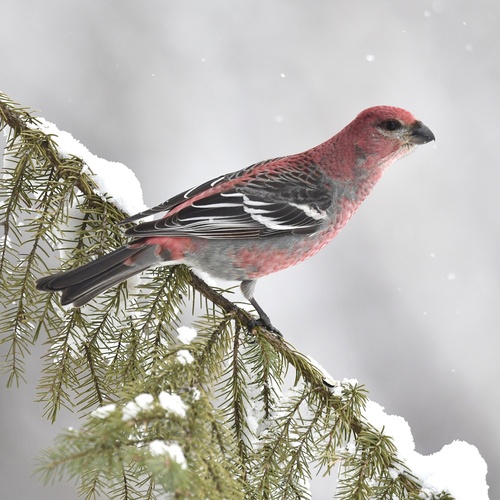
Pine Grosbeak
Pinicola enucleator
Meet the 'mope' of the north, a gentle giant among finches known for its stunning rosy plumage and calm demeanor. These hardy northern travelers occasionally grace southern backyards in spectacular winter irruptions, searching for their favorite berries.
Quick Identification
Size
Length 20-25.5 cm (7.9-10 in), wingspan 33 cm (13 in), weight 52-78 g (1.8-2.8 oz)
Colors
Adult males are raspberry-red with gray bellies; females and immatures are gray with golden-yellow or burnt-orange on the head and rump. Both have dark wings with two white bars.
Key Features
- Large, chunky finch with a heavy, slightly hooked black bill
- Adult males feature vibrant rosy-red plumage
- Dark gray wings accented by two distinct white wing bars
When You’ll See Them
Geographic range
Where Does the Pine Grosbeak Live?
The Pine Grosbeak is a true bird of the North, inhabiting a vast circumpolar range that stretches from Alaska and the high mountains of the Western United States across the Canadian boreal forest. In the Old World, they are found throughout subarctic Fennoscandia and across the massive Siberian taiga to the shores of the Pacific. While many populations are resident year-round, northern birds frequently venture south into the lower 48 states and Central Europe during 'irruption years' when their primary food sources fail.
Basemap © OpenStreetMap contributors
Behavior
Pine Grosbeaks are famously placid and slow-moving birds, earning them the nickname 'mopes' among early naturalists. Unlike many skittish songbirds, they are remarkably tame and will often allow humans to approach within a few feet while they calmly forage for buds or berries. They are social birds, usually seen in small family groups or flocks during the winter months.
Their flight is undulating and powerful, typical of large finches. While they spend much of their time in the canopy of coniferous trees, they frequently descend to the ground to eat fallen fruit or to grit—swallowing small pebbles to help digest tough seeds. Their song is a series of sweet, musical whistles that can be heard even in the depths of a subarctic winter.
EverydayEarth exclusive
Camera Tips
To capture the Pine Grosbeak on camera, focus on their love for winter fruit. If you have mountain ash, crabapple, or high-bush cranberry trees in your yard, mount your camera on a nearby branch or a tripod positioned 4-6 feet away. These birds are slow eaters and will often sit in one spot for several minutes, providing excellent opportunities for high-resolution stills and video.
During winter 'irruptions,' you can lure them to a specific spot using black oil sunflower seeds or suet, though fruit remains their preference. Set your camera at eye level (typically 5-7 feet high) near a sturdy perching branch. Because they are heavy birds, they prefer stable platforms over swaying tube feeders. A side-profile angle is best to highlight their unique hooked bill and the male's vibrant red plumage.
Since these birds are most active during the short days of winter, ensure your camera is set to handle low-light conditions or positioned to catch the morning sun. Use a fast trigger speed to capture them as they hop between branches. Because they are often found in snowy environments, manually adjust your camera's exposure or white balance if possible to prevent the bright snow from making the bird look like a dark silhouette.
Similar Species
Species that look similar or are commonly confused with Pine Grosbeak.
Purple Finch
Much smaller with a more pointed bill and no distinct white wing bars.
White-winged Crossbill
Features a unique crossed bill and a smaller, sleeker body compared to the bulky Grosbeak.
Evening Grosbeak
Shows yellow and black plumage rather than red/gray, with massive ivory-colored bills.
Frequently Asked Questions
Record Pine Grosbeak at your habitat
Connect a camera to start building your own species record — AI identifies every visitor automatically.