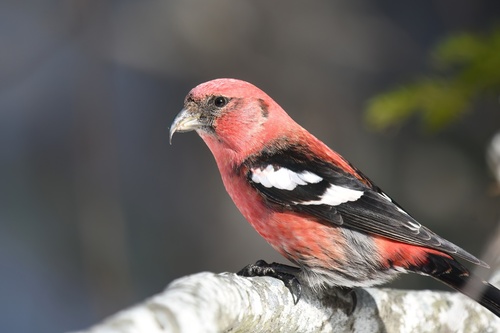
White-winged Crossbill
Loxia leucoptera
A colorful nomad of the boreal forest, the White-winged Crossbill is a master of survival. Its unique crossed beak and striking white wing bars make it one of the most fascinating finches to visit northern backyards.
Quick Identification
Size
Length: 15-17 cm (5.9-6.7 in); Wingspan: 26-29 cm (10.2-11.4 in); Weight: 24-40 g (0.8-1.4 oz)
Colors
Males are a vibrant rosy-pink or red with black wings and tail; females are yellowish-green or olive-gray. Both sexes feature two prominent white wing bars.
Key Features
- Specialized crossed mandibles (beak)
- Two bold white wing bars on black wings
- Deeply notched tail
- Stocky, large-headed finch silhouette
- Rosy-red (male) or greenish-yellow (female) plumage
When You’ll See Them
Geographic range
Where Does the White-winged Crossbill Live?
The White-winged Crossbill is a true nomad of the northern hemisphere, claiming a massive circumpolar range across North America and Eurasia. In the New World, they are native to the vast boreal forests stretching from Alaska across the width of Canada to Newfoundland, frequently dipping into the northern United States and the Rocky Mountains. Across the Atlantic, the species (often called the Two-barred Crossbill in Europe) inhabits the taiga of Russia, Scandinavia, and parts of North Asia, occasionally wandering as far south as Central Europe during major irruption years.
Basemap © OpenStreetMap contributors
Behavior
White-winged Crossbills are highly nomadic and social birds, often traveling in tight-knit flocks that can range from a few individuals to several hundred. They are famous for their 'irruptive' behavior, meaning they don't follow traditional migration patterns but instead wander across vast distances to find synchronized 'mast' crops of conifer seeds. Their social nature is evident in their constant chattering calls, which help the flock stay together as they move through the forest canopy.
When feeding, these finches exhibit parrot-like agility, frequently hanging upside down to reach cones at the tips of branches. They use their unique crossed beak as a specialized tool to pry open cone scales, using their tongue to extract the seed inside. Because they are so focused on high-energy conifer seeds, they are often surprisingly approachable by humans, especially when they descend to the ground to drink water or ingest grit and salt from roadsides.
EverydayEarth exclusive
Camera Tips
To capture the White-winged Crossbill on camera, placement is everything. Because these birds spend most of their time high in the canopy of spruce or larch trees, a ground-level camera is best positioned near a consistent water source. They are frequent drinkers, especially in winter when their seed-heavy diet requires significant hydration. A heated bird bath or a small opening in a frozen creek is a magnet for nomadic flocks. Position your camera about 2-3 feet from the water at a slight downward angle to capture the reflection and the intricate detail of their crossed mandibles.
While they don't typically visit standard bird feeders for sunflower seeds, you can lure them with 'grit' or salt. In many northern regions, crossbills are known to congregate on snowy roadsides to ingest road salt and small pebbles which help them digest tough seeds. Providing a safe, elevated platform with a mix of coarse sand and a tiny amount of mineral salt can sometimes attract a flock for a close-up. If you have ornamental conifers like hemlock or spruce in your yard, consider mounting a camera on a nearby pole at a height of 6-8 feet, directed at the cone-laden branches.
Because these birds are often fast-moving and social, use a camera with a fast trigger speed and a multi-shot 'burst' mode. You will often capture one bird landing, followed by five more seconds later. Since they are active during the day, standard daylight settings work well, but ensure your shutter speed is high (if adjustable) to freeze the motion of their fluttering wings as they hang upside down. Winter is the peak season for sightings in the lower 48 states and southern Canada, so ensure your batteries are rated for cold weather.
Similar Species
Species that look similar or are commonly confused with White-winged Crossbill.
Red Crossbill
Lacks the white wing bars and generally has a heavier bill and deeper red coloration.
Pine Siskin
Smaller and heavily streaked with yellow wing patches, lacking the crossed beak and rosy/green body color.
Pine Grosbeak
Much larger with a heavy, uncrossed beak; also has wing bars but lacks the specialized feeding posture.
Frequently Asked Questions
Record White-winged Crossbill at your habitat
Connect a camera to start building your own species record — AI identifies every visitor automatically.