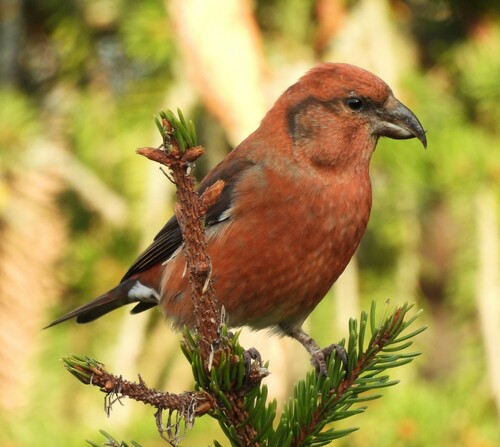
Red Crossbill
Loxia curvirostra
Meet the specialist of the pine barrens. With a beak perfectly evolved for prying open cones, the Red Crossbill is a colorful, nomadic wanderer of the northern forests.
Quick Identification
Size
Length: 5.5-7.9 in (14-20 cm); Wingspan: 10.6-11.4 in (27-29 cm); Weight: 0.8-1.8 oz (23-53 g)
Colors
Males are primarily brick red or reddish-orange with dark brown wings and tail; females are olive-yellow or greenish with yellowish rumps.
Key Features
- Mandibles crossed at the tips
- Stocky build with a large head
- Short, deeply notched tail
- Distinctive 'jip-jip' flight call
When You’ll See Them
Geographic range
Where Does the Red Crossbill Live?
The Red Crossbill is a widely distributed species found across the Northern Hemisphere. It is native to North America, spanning from the boreal forests of Alaska and Canada down through the western United States and into the high-altitude pine forests of Mexico. In the Old World, its range stretches across Europe and Northern Asia to the Pacific coast, with isolated populations even reaching North Africa. Because they are nomadic, their local presence is highly variable; a region might see thousands one year and none the next, depending on the success of conifer cone crops.
Basemap © OpenStreetMap contributors
Behavior
Red Crossbills are highly social and nomadic finches, best known for their specialized bills that act like precision tools. They use their crossed mandibles to pry apart the scales of conifer cones, using their tongues to extract the seeds hidden inside. Because they depend on unpredictable cone crops, they are 'nomadic,' meaning they do not follow traditional migration patterns but instead wander across continents to find areas with abundant food. They are even known to breed at almost any time of year, including mid-winter, as long as there is enough food to support a nest.
In the wild, you will often see them in small, noisy flocks moving through the tops of evergreens. They are surprisingly acrobatic, frequently hanging upside down to reach stubborn cones. While they spend most of their time in the canopy, they occasionally descend to the ground to drink or to grit—eating small pebbles and minerals that help them digest their tough seed-based diet. They are relatively unafraid of humans, but their high-altitude lifestyle makes them a 'lucky' find for most backyard observers.
EverydayEarth exclusive
Camera Tips
Capturing a Red Crossbill on camera requires a strategy focused on their two greatest needs: water and minerals. Because their diet is incredibly dry, they are frequent visitors to birdbaths. For the best results, place your AI camera 3 to 5 feet away from a heated birdbath or a shallow stone water feature. Set the camera at a low angle to capture the reflection of their vibrant red or yellow plumage in the water. Since they often travel in flocks, a wide-angle lens setting or a slightly pulled-back placement will help you capture multiple birds in a single frame.
If you live in an area with mature evergreens, consider a 'mineral station.' Red Crossbills are often attracted to salt or mineral-rich soil. Placing a small, flat tray of grit or a specialized bird mineral block in a sunny spot can lure them down from the canopy. Mount your camera on a nearby post at eye level (approx. 4-5 feet) to get clear, side-profile shots of their unique crossed beaks. Ensure the area is clear of tall grass so the camera's motion sensor isn't triggered by wind, focusing the AI's attention on the birds.
Lighting is crucial for showing off the male's brick-red color, which can look dull or brownish in deep shade. Position your camera facing north or south to utilize the 'golden hour' light of early morning or late afternoon without direct lens flare. During 'irruption' years—when food is scarce in the north—keep your camera active through the winter. They are one of the few species that might bring fledglings to your yard in the middle of a snowy February if you have a reliable water source and plenty of pine trees nearby.
Similar Species
Species that look similar or are commonly confused with Red Crossbill.
Frequently Asked Questions
Record Red Crossbill at your habitat
Connect a camera to start building your own species record — AI identifies every visitor automatically.