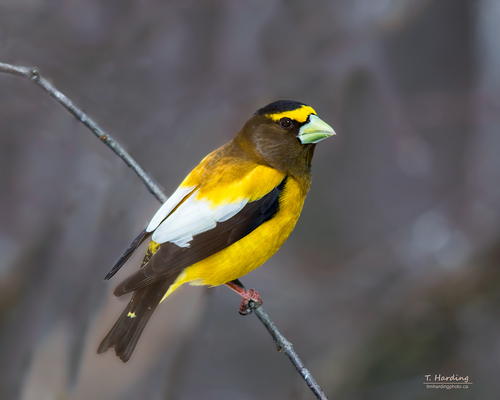
Evening Grosbeak
Hesperiphona vespertina
A stocky powerhouse of the finch family, the Evening Grosbeak dazzles with its massive ivory bill and bold golden plumage. These nomadic visitors turn any backyard into a bustling hub of activity during their rare and celebrated winter irruptions.
Quick Identification
Size
Length: 6.3–8.7 in (16–22 cm); Wingspan: 12–14 in (30–36 cm); Weight: 1.9–2.6 oz (53–74 g)
Colors
Males are brilliant yellow with black wings, a black tail, and a bright yellow forehead. Females are mostly silver-gray with yellow on the neck and white patches on the wings.
Key Features
- Massive, conical, pale-yellow or greenish bill
- Bold yellow 'eyebrow' on males
- Large white secondary wing patches
- Short, notched tail and stocky build
When You’ll See Them
Geographic range
Where Does the Evening Grosbeak Live?
Native to the North American continent, the Evening Grosbeak is found primarily across the northern United States and southern to central Canada. While their core breeding range remains in the high-elevation forests of the West and the boreal forests of the North, they are famous for their unpredictable winter movements. During 'irruption years,' these golden finches can be found as far south as the Gulf Coast and into the mountainous regions of central Mexico, seeking out dependable food sources in suburban backyards and mature woodlands.
Basemap © OpenStreetMap contributors
Behavior
Evening Grosbeaks are highly social finches, typically moving in large, boisterous flocks that can vary from a few individuals to dozens. They are famous for their irruptive migration patterns, meaning they don't follow a strict seasonal schedule but instead wander across the continent in search of abundant seed crops or insect outbreaks. When a flock descends on a backyard feeder, they are often noisy and dominant, using their sheer size and constant 'cleer' calls to claim the area.
These birds possess incredible bite force for their size, allowing them to crack open cherry pits and other hard seeds that most songbirds avoid. Despite their somewhat aggressive appearance at feeders, they are quite wary of ground predators and prefer to stay high in the canopy or on elevated platforms. In the summer, they become more elusive as they retreat into dense coniferous forests to breed, where they play a vital ecological role by consuming large quantities of forest pests like spruce budworms.
EverydayEarth exclusive
Camera Tips
To capture the best footage of Evening Grosbeaks, focus your camera on wide platform or tray feeders rather than hanging tubes. Because these birds travel in large, competitive flocks, they prefer a flat surface where multiple individuals can land and feed simultaneously. Position your camera approximately 2 to 3 feet from the feeder at eye-level to get high-definition shots of their massive bills and the intricate yellow-to-brown gradients on the males' plumage.
Baiting is essential for attracting these nomadic visitors. Fill your feeders with black oil sunflower seeds or striped sunflower seeds; their powerful bills make quick work of the shells, providing excellent 'action' shots. If you have maple or box elder trees in your yard, consider placing a trail camera nearby, as they often forage for the 'samara' winged seeds directly from the branches before visiting a feeder.
Water is a major secondary attractant. Evening Grosbeaks are known to be heavy drinkers and frequent bathers. A heated birdbath during the winter months is a foolproof way to capture unique social behaviors. Set your camera to a fast trigger speed or high-frame-rate video (60fps), as their movements while splashing or squabbling over food can be very rapid. Since they are most active in the early morning, ensure your camera is angled to avoid lens flare from the low winter sun.
Similar Species
Species that look similar or are commonly confused with Evening Grosbeak.
Frequently Asked Questions
Record Evening Grosbeak at your habitat
Connect a camera to start building your own species record — AI identifies every visitor automatically.