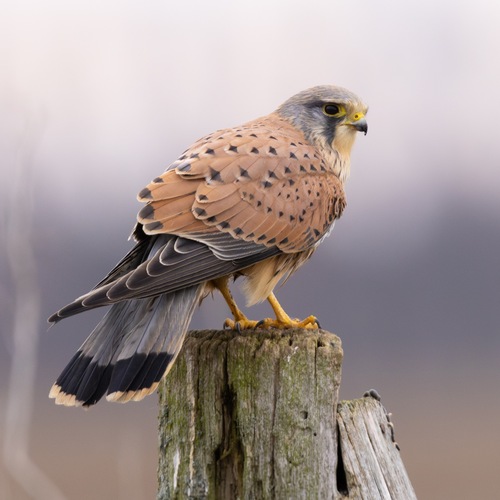
Eurasian Kestrel
Falco tinnunculus
The Eurasian Kestrel is a master of the air, famous for its ability to hover perfectly still while hunting. This charismatic falcon is a common visitor to open gardens and roadside perches across the Old World.
Quick Identification
Size
Length: 32–39 cm (13–15 in); Wingspan: 65–82 cm (26–32 in); Weight: 136–314 g (4.8–11 oz)
Colors
Males have a blue-grey head and tail with a chestnut-red back; females are reddish-brown with dark horizontal bars and streaks.
Key Features
- Specialized hovering 'windhovering' flight pattern
- Long, narrow tail with a dark terminal band
- Pointed wings typical of falcons
- Black 'mustache' streak below the eyes
When You’ll See Them
Geographic range
Where Does the Eurasian Kestrel Live?
The Eurasian Kestrel is native to a massive geographic area spanning the entirety of Europe, most of Asia, and large portions of Africa. This highly successful raptor is a familiar sight from the British Isles and the Mediterranean across the vast Russian steppes to the Japanese archipelago. In the southern parts of its range, it is a year-round resident, while populations in the colder northern reaches of Scandinavia and Siberia migrate to Southern Europe or Africa for the winter months.
Basemap © OpenStreetMap contributors
Behavior
The Eurasian Kestrel is most famous for its incredible ability to 'windhover.' While most birds of prey must keep moving to stay airborne, the kestrel can remain perfectly stationary in mid-air, its head fixed on a single point on the ground while its wings and tail make minute adjustments to the wind. This allows them to scan for the ultraviolet trails left by the urine of small rodents, a superpower that makes them highly efficient hunters.
These falcons are surprisingly adaptable to human environments. They are frequently seen perched on roadside wires, fence posts, or the limbs of solitary trees in open parks. While they are generally solitary outside of the breeding season, they are not particularly shy of human activity and will often nest on window ledges of tall buildings or in specialized nesting boxes provided by backyard enthusiasts.
EverydayEarth exclusive
Camera Tips
To capture a Eurasian Kestrel on your AI-powered camera, you need to think like a bird of prey looking for a vantage point. These falcons love high, stable perches that provide a clear view of short-grass areas. If you have a tall fence post, a dead 'snag' tree, or even a rooftop chimney, aim your camera at these specific landing spots. The camera should be positioned at a height of 2 to 4 meters, angled slightly downward toward the perch to capture the bird's arrival and departure.
Unlike many backyard birds, kestrels won't be attracted by birdseed or fruit. Instead, you can 'bait' the area indirectly by managing your lawn. If you leave a patch of grass to grow long, it will attract the voles and mice that kestrels hunt. Placing a camera near a high perch overlooking this long-grass 'wild zone' is a winning strategy. If you are lucky enough to have a kestrel nesting box, mount the camera about 2 meters away from the entrance to capture the dramatic moments of food delivery without obstructing the birds' flight path.
Because kestrels move with explosive speed when they dive, camera settings are critical. Use a fast trigger speed (less than 0.5 seconds) and set your camera to take a burst of 3-5 photos or a high-frame-rate video. This ensures you catch the bird mid-hover or during its characteristic 'strike' posture. Since they are strictly diurnal, you can save considerable battery life by setting your camera to only operate during daylight hours. In the winter, kestrels are more likely to return to the same favorite perch day after day to conserve energy, making it the perfect time for long-term monitoring.
Similar Species
Species that look similar or are commonly confused with Eurasian Kestrel.
Lesser Kestrel
Smaller with paler plumage; males lack the dark spots on their chestnut backs found on Eurasian Kestrels.
Eurasian Sparrowhawk
Has broader, rounded wings and a much faster, flapping flight pattern without the stationary hovering.
Peregrine Falcon
Significantly larger and bulkier with a much wider black 'hood' or mustache mark.
Frequently Asked Questions
Record Eurasian Kestrel at your habitat
Connect a camera to start building your own species record — AI identifies every visitor automatically.