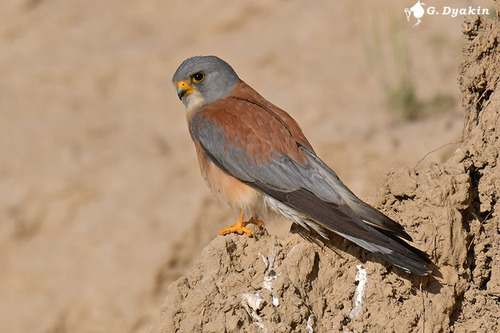
Lesser Kestrel
Falco naumanni
A social and striking falcon of the open plains, the Lesser Kestrel is famous for its acrobatic flight and preference for ancient ruins. This insect-loving raptor brings a flash of chestnut and blue-grey to the Mediterranean and Asian skies.
Quick Identification
Size
Length: 27–33 cm (11–13 in); Wingspan: 58–72 cm (23–28 in); Weight: 90–210 g (3.2–7.4 oz)
Colors
Males have an unspotted rufous back, blue-grey head and tail, and a grey wing patch. Females are brown and streaked with a paler underside.
Key Features
- Blue-grey head and unspotted chestnut back in males
- Pale or whitish claws (unlike the black claws of the Common Kestrel)
- Highly social, often seen in large colonies
- Agile hovering flight while hunting
When You’ll See Them
Geographic range
Where Does the Lesser Kestrel Live?
Native to the Palearctic region, the Lesser Kestrel breeds across the Mediterranean basin, through the Middle East and Central Asia, extending as far east as Mongolia and China. As a migratory species, it spends its winters in Sub-Saharan Africa, with some populations traveling as far south as South Africa. While they have faced declines in Western Europe, they remain a common sight in the vast steppes of Kazakhstan and Turkey.
Basemap © OpenStreetMap contributors
Behavior
The Lesser Kestrel is an exceptionally social raptor, a trait that sets it apart from many of its more solitary falcon relatives. They are colonial nesters, frequently congregating in groups of dozens or even hundreds of pairs. These colonies are often established in old buildings, ruins, or under the tiled roofs of Mediterranean villages, where the birds fill the air with their distinctive chattering calls. They are not particularly shy of humans and have adapted well to life in traditional agricultural landscapes.
During the day, they are active hunters that use a combination of perched scanning and hovering to locate prey. Unlike larger falcons that strike birds in mid-air, the Lesser Kestrel is primarily an insect-eater, hovering gracefully over tall grass before dropping down to snatch a grasshopper or beetle. They are also known for their long-distance migrations; every autumn, they travel in large flocks across the Mediterranean and Sahara to reach their wintering grounds in Sub-Saharan Africa.
EverydayEarth exclusive
Camera Tips
To capture the Lesser Kestrel on a backyard or trail camera, focus your efforts on their nesting sites. Because they are colonial, they often return to the same holes in old walls or specialized nest boxes year after year. Position your camera on a mount at least 2 to 3 meters away from a nest entrance, ensuring it is angled slightly upward to capture the birds as they arrive with food. Use a high-speed trigger setting, as these falcons are incredibly fast and can enter a nest hole in the blink of an eye.
If you aren't near a nesting colony, look for prominent perches in open fields. Lesser Kestrels love to scan for insects from fence posts, T-shaped wooden perches, or dead tree branches. Placing a camera facing one of these 'lookout posts' during the morning hours (8-11 AM) provides an excellent opportunity for clear, stationary shots. Since they are attracted to large insect populations, placing your camera near areas of tall, untreated grass where grasshoppers are abundant can also yield results.
Lighting is critical for distinguishing the male's vibrant blue-grey head from the female's brown plumage. Aim for a south-facing setup to capture the golden hour light during the late afternoon, which is another peak activity period for hunting. Because these birds have keen eyesight, try to camouflage your camera housing with materials that match the stone or wood of their environment to avoid making them wary of the lens.
Similar Species
Species that look similar or are commonly confused with Lesser Kestrel.
Frequently Asked Questions
Record Lesser Kestrel at your habitat
Connect a camera to start building your own species record — AI identifies every visitor automatically.