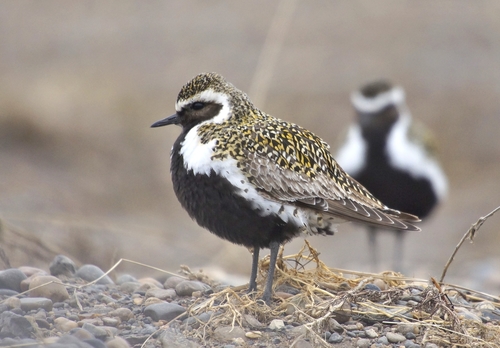
European Golden-Plover
Pluvialis apricaria
A shimmering icon of the uplands, the European Golden-Plover transforms from a cryptic moorland nester into a dazzling gold-and-black nomad of the winter fields.
Quick Identification
Size
Length 26–29 cm (10–11.5 in), wingspan 67–76 cm (26–30 in), weight 160–280 g (5.6–9.9 oz)
Colors
Upperparts spangled with gold and black. In breeding season, males feature a jet-black face, throat, and belly bordered by a broad white stripe. Winter plumage is more uniform golden-brown with pale buff underparts.
Key Features
- Gold-spangled plumage on back and wings
- Pure white axillary (armpit) feathers visible in flight
- Black underparts with white border (breeding male)
- Short, dark bill and stocky, rounded body shape
When You’ll See Them
Geographic range
Where Does the European Golden-Plover Live?
This stunning wader is native to the Palearctic region, with its core breeding grounds stretching across Iceland, the British Isles, Scandinavia, and northern Russia. During the colder months, the population migrates south and west to find milder climates, wintering extensively across Western Europe, the Mediterranean basin, and parts of North Africa. While they are a quintessentially European species, their winter movements are highly nomadic, shifting based on frost and snow cover.
Basemap © OpenStreetMap contributors
Behavior
The European Golden-Plover is a bird of two worlds. During the summer, it is a solitary and cryptic resident of high-altitude moorlands and arctic tundra, where its golden plumage provides near-perfect camouflage against lichen and moss. Males perform impressive song-flights, circling high above their territory with slow, rhythmic wingbeats to attract mates and warn off rivals.
In the winter, their behavior shifts dramatically as they become highly gregarious. They gather in massive, shimmering flocks often numbering in the thousands, frequently associating with Northern Lapwings. These flocks are highly coordinated, performing aerial maneuvers that resemble clouds of smoke as they turn in unison. They are visual foragers, using a 'run-stop-peck' method to locate prey on the surface of the soil, often remaining active through moonlit nights.
EverydayEarth exclusive
Camera Tips
To capture the European Golden-Plover on your backyard or trail camera, focus on open, flat spaces with short vegetation. Because these birds are ground-dwellers with a 360-degree field of vision, the camera should be mounted very low to the ground—no more than 15 to 30 centimeters (6 to 12 inches) high. Use a wide-angle lens if possible to capture the scale of winter flocks, or a telephoto setup aimed at a known 'loafing' spot where they rest during the day.
Placement is everything. In winter, look for large, recently ploughed fields or damp pastures where earthworms are active. They are often found alongside Northern Lapwings, so if you see 'Peewits' in your area, the Golden-Plover isn't far behind. Since they are sensitive to movement, ensure your camera is well-camouflaged and has a fast trigger speed; these birds are quick and will often scurry out of the frame before the shutter fires.
Consider the lighting. Their golden plumage truly glows during the 'golden hour' of sunrise and sunset. Setting your camera to capture high-frame-rate bursts or short 4K video clips will help you document their unique 'run-and-pause' feeding behavior. In cold weather, they are more likely to feed throughout the night, especially under a full moon, so ensure your camera's infrared flash is optimized for clear monochrome night shots without overexposing the bird's reflective feathers.
Similar Species
Species that look similar or are commonly confused with European Golden-Plover.
Frequently Asked Questions
Record European Golden-Plover at your habitat
Connect a camera to start building your own species record — AI identifies every visitor automatically.