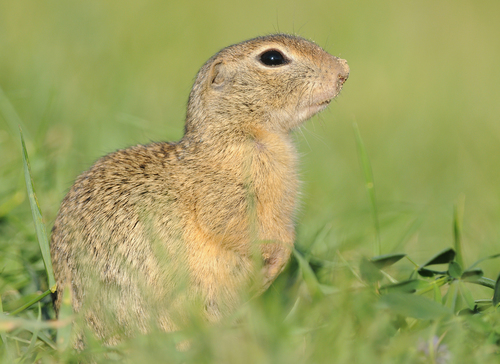
European Ground Squirrel
Spermophilus citellus
Meet the "Watchman of the Steppe," a social and whistling rodent that thrives in the sun-drenched grasslands of Central Europe. These charismatic burrowers are famous for their upright sentry poses and complex colony life.
Quick Identification
Size
Length: 18-23 cm (7-9 in); Tail: 4-7 cm (1.5-2.8 in); Weight: 200-450g (7-16 oz)
Colors
Yellowish-gray to sandy brown upper parts with faint, pale spotting; creamy white or yellowish underparts; dark eyes with pale rings.
Key Features
- Short, bushy tail less than half the body length
- Large, dark eyes set high on the head
- Small, inconspicuous ears
- Stands upright on hind legs to survey surroundings (sentry pose)
When You’ll See Them
Geographic range
Where Does the European Ground Squirrel Live?
This charismatic rodent is native to the open landscapes of Eastern and Central Europe. Its core population spans a wide belt from the Czech Republic and Austria through the Pannonian Basin of Hungary into the Balkan Peninsula and as far east as southern Ukraine and European Turkey. Interestingly, its range is split into two distinct segments by the towering Carpathian Mountains, which act as a natural barrier to these lowland-loving animals.
Basemap © OpenStreetMap contributors
Behavior
European ground squirrels are highly social, diurnal rodents that live in complex underground burrow systems. They are famously known for their "sentry" behavior, where individuals stand tall on their hind legs to scan for predators like hawks or foxes, emitting a sharp, whistling alarm call to warn the colony. Most of their day is spent foraging or maintaining their burrows, which have separate chambers for nesting and food storage.
Unlike many other squirrels, they are strict hibernators. They disappear underground in late summer or autumn and remain dormant until the first warm days of spring. While they generally avoid dense human settlements, they have adapted well to modified landscapes like mown pastures, airfields, and even quiet golf courses, where the grass is kept short enough for them to spot threats from a distance.
EverydayEarth exclusive
Camera Tips
To capture the perfect shot of a European ground squirrel, placement is everything. These animals are strictly ground-dwellers, so your camera needs to be positioned very low—no more than 20 to 30 centimeters (8-12 inches) off the ground. Aim the lens toward an active burrow entrance or a flat, sun-drenched patch of short grass where they are likely to forage. Because they are small and move quickly, use a high shutter speed or a 'burst' photo mode to avoid motion blur.
Timing is crucial due to their long hibernation period. You will only find them active from roughly March or April until August or September. They are most active during bright, sunny mornings and late afternoons when the light is golden—perfect for high-quality imagery. Avoid setting up during rainy weather, as they prefer to stay underground in their dry tunnels when it pours.
While we don't recommend heavy baiting for endangered species, placing a few sunflower seeds or pieces of apple near a "sentinel post" (a small mound or rock) can encourage them to pause in front of your lens. Ensure your camera has a fast trigger speed, as their 'bolt-to-burrow' reflex is lightning fast. If your camera supports it, the 4K video setting is excellent for capturing their characteristic 'tail-flicking' and whistling communication.
Similar Species
Species that look similar or are commonly confused with European Ground Squirrel.
Frequently Asked Questions
Record European Ground Squirrel at your habitat
Connect a camera to start building your own species record — AI identifies every visitor automatically.