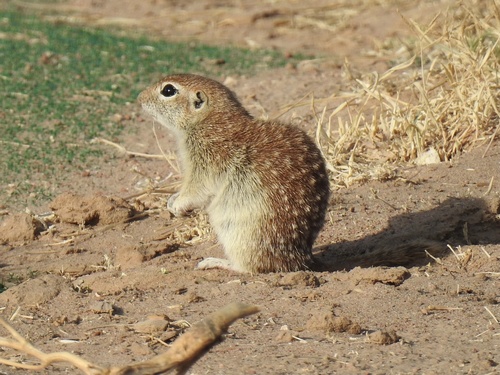
Spotted Ground Squirrel
Xerospermophilus spilosoma
Discover the 'phantom' of the grasslands—the Spotted Ground Squirrel. One of North America's smallest and most elusive rodents, these desert-dwellers are masters of camouflage and underground engineering.
Quick Identification
Size
Length: 18–25 cm (7–10 in); Weight: 100–200 g (3.5–7 oz)
Colors
Sandy brown to cinnamon-gray upperparts covered in distinct white or buff-colored spots; creamy white belly and throat
Key Features
- Distinctive white spots scattered across a brownish back
- Small, slender build with a short, hairy tail
- Short, rounded ears that barely protrude from the head
- Lacks the long stripes found on chipmunks or thirteen-lined ground squirrels
When You’ll See Them
Geographic range
Where Does the Spotted Ground Squirrel Live?
Native to the North American continent, the Spotted Ground Squirrel occupies a vast swath of the central and western United States and much of central Mexico. Its core range extends from the high plains of South Dakota and Nebraska southward through the Chihuahuan and Sonoran Deserts. These hardy rodents are most frequently encountered in the arid landscapes of Texas, New Mexico, and Arizona, reaching as far south as the Mexican states of Zacatecas and Puebla.
Basemap © OpenStreetMap contributors
Behavior
Spotted Ground Squirrels are elusive, shy rodents that spend a significant portion of their lives underground. Unlike many of their more social relatives, they tend to be somewhat solitary, though several individuals may establish burrows in the same general area if the soil and food sources are ideal. They are strictly diurnal, meaning they are active during the day, typically emerging from their burrows shortly after sunrise to forage and bask in the sun.
These squirrels are expert excavators, creating complex burrow systems with multiple entrances, often cleverly hidden under the shade of a desert shrub or near rocky outcrops. When they sense danger, they emit a high-pitched, whistled alarm call to warn others before quickly vanishing into the safety of their tunnels. Because they inhabit arid regions, they have adapted to survive long periods without standing water, obtaining most of their hydration from the plants they eat.
EverydayEarth exclusive
Camera Tips
To capture these shy squirrels on camera, placement is everything. Position your camera very low to the ground—no more than 6 to 10 inches high. Aim the lens toward the edge of a shrub or a patch of bare, sandy soil where you have spotted burrow openings or small tracks. Because they are small and move with sudden, darting motions, use a fast trigger speed (under 0.5 seconds) and set your camera to 'Burst Mode' or short 10-second video clips to ensure you catch them before they move out of frame.
While they don't typically visit traditional bird feeders, you can entice them into your camera's field of view by scattering a small amount of native grass seeds, cracked corn, or unsalted sunflower seeds near a known burrow entrance. Avoid placing the bait in the middle of a wide-open space; these squirrels feel vulnerable to hawks and other predators and prefer to stay near the safety of vegetation or their holes. A little bit of cover like a flat rock or a log near the bait can make them feel secure enough to linger for a photo.
Since Spotted Ground Squirrels are most active during the warmest parts of the day in spring and summer, ensure your camera isn't facing directly into the sun to prevent washed-out images or 'false triggers' caused by moving heat waves. Early morning and late afternoon provide the best natural lighting to highlight their unique spotted patterns. Keep in mind that they hibernate from late autumn through early spring, so focus your monitoring efforts during the warmer months when they are actively gathering food for the winter.
Similar Species
Species that look similar or are commonly confused with Spotted Ground Squirrel.
Thirteen-lined Ground Squirrel
Features long, distinct white stripes along its back rather than scattered spots.
Mexican Ground Squirrel
Larger in size with nine very distinct rows of white spots on its back.
Round-tailed Ground Squirrel
Has a much more uniform, unspotted sandy coat and a longer, more cylindrical tail.
Frequently Asked Questions
Record Spotted Ground Squirrel at your habitat
Connect a camera to start building your own species record — AI identifies every visitor automatically.