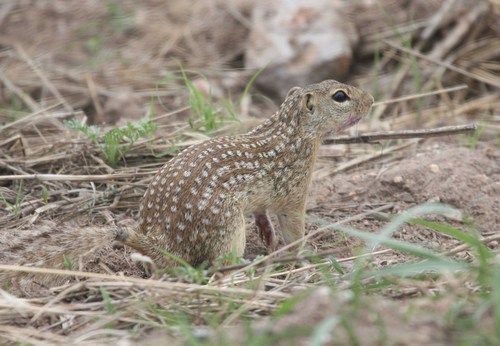
Mexican Ground Squirrel
Ictidomys mexicanus
Recognizable by the nine neat rows of spots dancing across its back, the Mexican Ground Squirrel is a master of the sun-drenched southern plains. This alert and industrious burrower is a delightful sight for any backyard observer in the Southwest.
Quick Identification
Size
28-38 cm (11-15 inches) in total length; weight ranges from 200-470 grams (7-16 oz)
Colors
Brownish-grey to reddish-brown coat featuring nine rows of distinct creamy-white spots; pale buff or white underbelly
Key Features
- Nine rows of distinct light spots on the back
- Small, rounded ears set low on the head
- Slender, moderately bushy tail
- Picket-pin upright standing posture when alert
When You’ll See Them
Geographic range
Where Does the Mexican Ground Squirrel Live?
Native to the North American continent, the Mexican Ground Squirrel occupies a wide swathe of territory spanning from the southern United States into central Mexico. Its range begins in the Texas Panhandle and southeastern New Mexico, stretching southward through the Rio Grande Valley and deep into the Mexican Plateau, reaching as far south as the states of Jalisco and Puebla. They are highly successful in the brushy transition zones where the desert meets more temperate grasslands.
Basemap © OpenStreetMap contributors
Behavior
The Mexican Ground Squirrel is a social yet cautious rodent that is primarily diurnal, meaning it is most active during the daylight hours. Unlike many other mammals that avoid the midday sun, these squirrels are frequently seen foraging during the hottest parts of the day. They are expert excavators, living in complex underground burrow systems that feature multiple entrances, dedicated nesting chambers, and food storage areas. These burrows provide essential protection from the intense heat and common predators like hawks, snakes, and coyotes.
When they aren't foraging, they spend a significant amount of time near their burrow entrances, often standing perfectly still on their hind legs—a behavior known as the 'picket-pin' stance—to scan for danger. While they are generally solitary in their specific burrow, they often live in loose colonies where individuals stay within earshot of one another's alarm whistles. In the northern parts of their range, they undergo a period of dormancy or true hibernation during the winter months, typically retreating underground from late autumn until early spring.
EverydayEarth exclusive
Camera Tips
To successfully capture a Mexican Ground Squirrel on camera, placement is everything. These squirrels are low-slung and tend to stick to familiar paths or 'runways' between their burrow and feeding grounds. Position your camera very low—ideally just 6 to 10 inches off the ground—and angle it slightly downward. Mounting the camera on a short stake or a weighted base on the ground is often more effective than using a tree trunk, as it allows for a more natural eye-level perspective of their activities.
Since these squirrels are most active during the bright midday sun, avoid placing the camera in areas with heavy, dappled shadows, which can cause 'false triggers' as the wind moves tree branches. A clear, sunlit patch of short grass or bare earth near a burrow entrance is the ideal stage. If you want to encourage them to pause in front of the lens, a small scattering of black oil sunflower seeds or dried corn can be very effective. Place the bait roughly 3 to 5 feet away from the lens to ensure the animal stays within the focal range and the frame.
For the best results, use a fast shutter speed or a high-frame-rate video setting. Mexican Ground Squirrels are prone to sudden, twitchy movements and can disappear into a burrow in a split second. A 10-15 second video clip is often more rewarding than a still photo, as it may capture their unique 'tail-flicking' communication or their iconic upright standing posture. Remember that these animals hibernate, so focus your camera efforts during the warmer months from late spring through early autumn.
Similar Species
Species that look similar or are commonly confused with Mexican Ground Squirrel.
Thirteen-lined Ground Squirrel
Displays long, continuous solid white stripes between rows of spots, whereas the Mexican variety has only rows of spots.
Spotted Ground Squirrel
Smaller with smaller, more randomly scattered spots that do not form neat, organized rows.
Rock Squirrel
Much larger with a significantly bushier, longer tail and a mottled gray coat without distinct rows of white spots.
Frequently Asked Questions
Record Mexican Ground Squirrel at your habitat
Connect a camera to start building your own species record — AI identifies every visitor automatically.