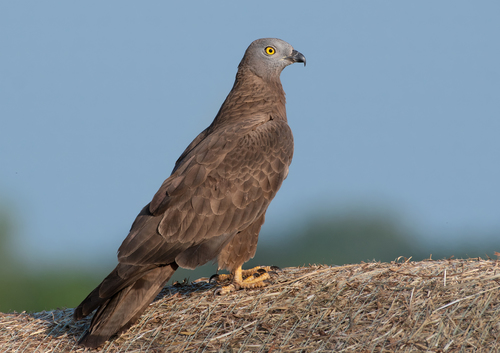
European Honey-buzzard
Pernis apivorus
Meet the forest's most specialized raptor, a bird of prey that ignores mice and rabbits in favor of underground wasp nests. With its unique 'scale' feathers and pigeon-like profile, the European Honey-buzzard is a master of the summer woodland.
Quick Identification
Size
Length: 52-60 cm (20-24 in); Wingspan: 135-150 cm (53-59 in); Weight: 440-1,050 g (1-2.3 lbs)
Colors
Extremely variable; generally brownish to grey-brown upperparts and pale underparts with dark bars or spots. Males often have a distinct blue-grey head, while females are more uniformly brown.
Key Features
- Small pigeon-like head with a long, thin neck
- Long tail with two narrow dark bands near the base and one broad band at the tip
- Yellow eyes and slit-like nostrils protected by scale-like feathers
- Broad wings with rounded 'fingers' at the tips
When You’ll See Them
Geographic range
Where Does the European Honey-buzzard Live?
Native to the vast temperate forests of Europe and Western Asia, the European Honey-buzzard spans a summer breeding range from Great Britain and Iberia all the way to the Ob River in Siberia. As a strictly migratory species, it abandons its northern territories in late summer to fly southward to sub-Saharan Africa, where it spends the winter months in tropical forests and savannas. Its presence is most concentrated in countries like France, Germany, and Russia during the warmer months before they converge on southern migration corridors.
Basemap © OpenStreetMap contributors
Behavior
The European Honey-buzzard is a fascinating specialist among raptors, having evolved specifically to hunt social insects. Unlike most birds of prey that swoop from the sky to grab mammals or birds, this species spends a significant amount of time on the forest floor, using its strong feet to excavate the underground nests of wasps and bees. They are remarkably patient, often sitting motionless in the canopy for long periods, watching for the flight paths of insects to locate their hidden hives.
Despite their name, they don't actually eat honey; they are after the protein-rich larvae and pupae. During the breeding season, they are elusive and quiet to avoid drawing attention to their nests, but they become highly visible during their spectacular migrations. They are long-distance travelers, avoiding large water crossings and instead funneling through bottlenecks like Gibraltar or the Bosphorus by the thousands.
EverydayEarth exclusive
Camera Tips
Capturing a European Honey-buzzard on a trail camera requires a bit of detective work since they are far less likely to visit a traditional bird feeder than a Common Buzzard. The best strategy is to locate an active ground-nesting wasp or hornet colony in late summer. Position your camera on a low tripod or strap it to a nearby tree trunk, about 30 to 50 centimeters (12-20 inches) off the ground, angled slightly downward toward the hive entrance. These birds are methodical excavators and will often return to the same hole until the nest is depleted.
Since these birds are cautious, use a camera with a fast trigger speed and high-resolution video capabilities to capture the unique behavior of them using their feet to dig. Avoid using 'glow' IR flashes if possible; while they are diurnal, a 'no-glow' black LED flash is less likely to startle them if they are still foraging as dusk approaches. Set your camera to take bursts of 3-5 photos or 20-second video clips to capture the digging action.
If you are setting up in a woodland clearing, look for 'plucking posts' or areas where they might perch to scan for insects. Placing a camera near a shallow forest pool can also be productive, as they frequently drink and bathe during the heat of the day. Because they are migratory, your best window for success is between late May and early September. Be sure to check your local laws regarding proximity to raptor nests, as these birds can be sensitive to disturbance during the early breeding phase.
Similar Species
Species that look similar or are commonly confused with European Honey-buzzard.
Frequently Asked Questions
Record European Honey-buzzard at your habitat
Connect a camera to start building your own species record — AI identifies every visitor automatically.