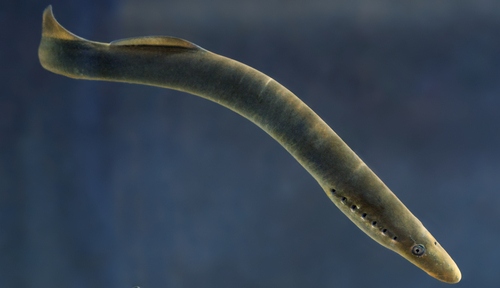
European River Lamprey
Lampetra fluviatilis
An ancient wanderer of Europe's rivers, the European River Lamprey is a jawless marvel of evolution that bridges the gap between the deep sea and our freshwater streams.
Quick Identification
Size
30 to 50 cm (12 to 20 inches) in length; 50 to 150 grams
Colors
Dark grey to olive-green back, silvery-white flanks, and a pale belly
Key Features
- Elongated eel-like body without scales or paired fins
- Circular sucking disc mouth with small, sharp teeth
- Seven distinct circular gill pores on each side of the head
When You’ll See Them
Geographic range
Where Does the European River Lamprey Live?
Native to the coastal waters and river systems of Europe, the European River Lamprey is primarily found from the western Mediterranean north to the lakes of Finland and Russia. Its core range includes the British Isles, the Baltic Sea basin, and major river systems across France and Germany. This species is strictly tied to accessible, unpolluted waterways that provide a clear passage between the sea and inland spawning grounds.
Basemap © OpenStreetMap contributors
Behavior
The European River Lamprey is a remarkable 'living fossil' that has remained largely unchanged for millions of years. As an anadromous species, it spends its adult life at sea or in estuaries, where it leads a parasitic lifestyle, before migrating into freshwater rivers to spawn. Unlike typical fish, lampreys lack jaws and a bony skeleton, possessing instead a flexible cartilaginous structure that allows them to undulate through the water with great agility.
During their freshwater migration, which begins in late autumn, adults cease feeding entirely and rely on stored fat. Their social behavior is most evident during the spring spawning season, when they gather in groups on gravelly riverbeds. They are known for their unique 'nest-building' behavior, using their suction-cup mouths to physically move stones and create depressions in the riverbed. Although they are often feared due to their parasitic nature at sea, they pose no threat to humans and are an indicator of high water quality.
EverydayEarth exclusive
Camera Tips
Capturing the European River Lamprey on camera requires a specialized underwater approach, as they are almost never visible from above the surface. If your backyard includes a stream or river, focus your efforts during the spring spawning run (March to May). Identify 'redds,' which are shallow pits in the gravel where lampreys congregate. Place an underwater action camera or a waterproofed trail camera weighted with a diving weight directly on the riverbed, facing slightly upstream toward these gravel patches.
Since lampreys are predominantly nocturnal and highly sensitive to light, avoid using standard white-light LEDs, as these will likely scare them away. Instead, use a camera with high-quality Infrared (IR) capabilities. In very shallow water, you can sometimes achieve great results by positioning the camera at the water's edge looking inward, but for the best detail of their stone-moving behavior, a fully submerged setup is necessary. Set your camera to time-lapse mode (one photo every 30 seconds) or use a high-sensitivity video trigger, though PIR sensors often struggle to work effectively through water.
Water clarity is the most important factor for a successful 'capture.' Schedule your recording sessions for periods of dry weather when the river is low and clear. After heavy rain, suspended silt will reflect your camera's IR light, resulting in a 'snowstorm' effect. If you find a group of lampreys, try to keep the camera lens within 2-3 feet of the activity for maximum resolution of their unique oral discs and gill pores.
Similar Species
Species that look similar or are commonly confused with European River Lamprey.
Frequently Asked Questions
Record European River Lamprey at your habitat
Connect a camera to start building your own species record — AI identifies every visitor automatically.