European Stag Beetle
Lucanus cervus
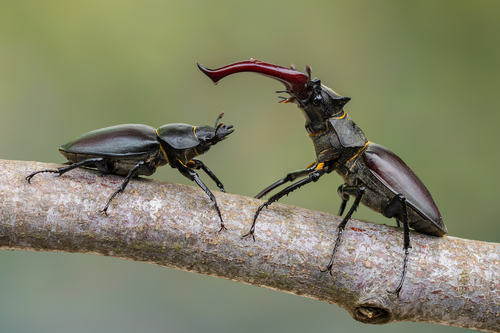
The European Stag Beetle is the crown jewel of backyard insects, featuring the male's iconic antler-like mandibles. This 'Near Threatened' giant is a sign of a healthy garden ecosystem, emerging on warm summer nights to find a mate.
Quick Identification
Size
Males range from 50-75 mm (2-3 inches); females are smaller at 30-50 mm (1.2-2 inches)
Colors
Dark brown to black body with chestnut or reddish-brown wing cases; males have large orange-to-brown mandibles
Key Features
- Large antler-like mandibles in males
- Reddish-brown wing cases (elytra)
- Robust body reaching up to 7.5cm in length
- Females have small but powerful black pincers
When You’ll See Them
Geographic range
Where Does the European Stag Beetle Live?
Native to the European continent, the European Stag Beetle is most commonly found in the temperate regions of Western and Central Europe, including the United Kingdom, France, and Germany. Its range extends eastward toward the Caspian Sea and southward into the Mediterranean basin and parts of North Africa. While its distribution has become fragmented due to habitat loss, it remains a localized specialist in areas where old-growth broadleaf forests and garden woodpiles provide necessary breeding grounds.
Basemap © OpenStreetMap contributors
Behavior
European Stag Beetles spend the vast majority of their lives—up to seven years—underground as larvae, feeding on decaying wood. Once they emerge as adults in the late spring or early summer, their focus shifts entirely to reproduction. During this brief adult phase, which lasts only a few weeks, males engage in dramatic wrestling matches, using their massive mandibles to toss rivals off logs or branches in a display of dominance for female attention.
These beetles are most active during warm, humid evenings. While they may look intimidating, they are harmless to humans; the male's 'antlers' are too weak to deliver a painful pinch, though the smaller females have a much stronger grip. They are often seen flying at head height in a vertical orientation, searching for mates or tree sap leaks near old trees.
EverydayEarth exclusive
Camera Tips
To capture the European Stag Beetle on camera, focus your efforts on 'staging areas' such as large piles of decaying logs, old stumps, or the bases of mature oak and beech trees. Position your camera very low to the ground—no more than 10 to 20 centimeters high—and angle it slightly upward to catch the beetles as they crawl over wood or prepare for takeoff. A wide-angle lens with a short focal distance is ideal for showing these insects in their environment.
Because these beetles are crepuscular, timing is everything. Set your camera to trigger most frequently during the 'golden hour' and the first few hours of darkness in June and July. If your camera supports it, use a high-sensitivity motion trigger, as insects can sometimes fail to trip standard PIR sensors. Adding a small amount of sweet bait, like a piece of overripe fruit or a sponge soaked in sugary water, near the camera can lure them into the frame, though natural tree sap leaks are the best attractants.
Lighting can be tricky at dusk. If you use a flash, try to diffuse it to avoid harsh reflections off their shiny carapaces. If your camera has a 'time-lapse' mode, consider setting it to take a photo every 30 seconds during peak activity hours; this often captures more beetle movement than motion-triggering alone, especially when they are slowly patrolling a log for mates.
Similar Species
Species that look similar or are commonly confused with European Stag Beetle.
Frequently Asked Questions
Record European Stag Beetle at your habitat
Connect a camera to start building your own species record — AI identifies every visitor automatically.