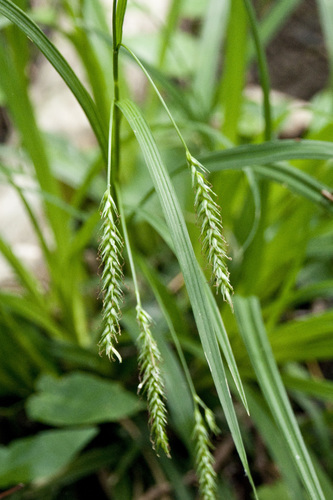
European Woodland Sedge
Carex sylvatica
With its elegant, fountain-like clumps and delicate drooping seed heads, the European Woodland Sedge is the emerald jewel of the shaded forest floor. A hardy and non-invasive beauty, it brings the serene atmosphere of ancient woods right into your backyard.
Quick Identification
Size
30–60 cm (12–24 in) tall; leaves 4–8 mm (0.15–0.31 in) wide
Colors
Bright yellowish-green foliage; flower spikes are pale green, maturing to a light chestnut brown
Key Features
- 3-5 long, drooping (pendent) female spikes on hair-like stalks
- A single upright male spike at the very top of the stem
- Neat, tufted growth habit without spreading underground runners
When You’ll See Them
Geographic range
Where Does the European Woodland Sedge Live?
Native to the cool, temperate regions of Europe, the European Woodland Sedge is found abundantly from the British Isles across to the Caucasus and stretching into parts of North Africa. It is a quintessential plant of the European forest floor, particularly in countries like Germany, France, and the UK, where it thrives under the deep shade of broadleaf trees. Due to its popularity in ornamental horticulture, it has also established naturalized populations in North America and New Zealand, where it continues to favor moist, shaded habitats similar to its home range.
Basemap © OpenStreetMap contributors
Behavior
The European Woodland Sedge is a graceful perennial that serves as a cornerstone of ancient deciduous forest ecosystems. Unlike many other members of the Carex family that spread aggressively via rhizomes, this species grows in polite, arching clumps (known as cespitose growth). This makes it a non-invasive favorite for naturalistic gardening, where it provides a soft, fountain-like texture to shady corners. It is often regarded as an indicator species for established, healthy woodland, signaling a site that has remained undisturbed for many years.
As a plant, its "behavior" is dictated by the light and soil of the forest floor. It is remarkably shade-tolerant, utilizing its bright green leaves to capture the limited sunlight filtering through the canopy of oak, beech, or ash trees. Throughout the year, it provides vital structural complexity to the ground layer, offering shelter for ground-dwelling invertebrates and a stabilizing root system for damp, sloping soils. In the spring, its delicate flowering spikes emerge, swaying with the slightest breeze to facilitate wind pollination.
EverydayEarth exclusive
Camera Tips
Capturing the subtle beauty of the European Woodland Sedge on a backyard or trail camera requires a different approach than filming wildlife. Because the plant is stationary, standard motion-triggered recording won't work unless there is significant wind. Instead, use your camera's time-lapse function. Setting an interval of one photo every 60 minutes allows you to document the plant's seasonal journey—from the first bright green shoots in early spring to the emergence of the iconic drooping seed heads in May and June.
For the most professional-looking shots, position your camera on a low-profile mount or a small tripod just 12 to 15 inches above the ground. Angle the lens slightly upward to emphasize the "pendent" or hanging nature of the female spikes. Since this sedge loves dappled shade, the lighting can be tricky; try to position the camera so the sun is behind or to the side of the plant during the golden hours of early morning. This creates a backlighting effect that makes the translucent green leaves and delicate stalks glow against the darker forest floor.
Don't just focus on the plant itself—use it as a "biodiversity stage." The dense tufts of the European Woodland Sedge are often visited by foraging birds like thrushes or robins looking for insects, and small mammals like wood mice often use the arching leaves for cover. By placing your camera near a healthy clump, you increase your chances of capturing these small-scale interactions. During the winter, the plant’s semi-evergreen nature provides a rare splash of green in a dormant landscape, making it an excellent foreground element for winter wildlife photography.
Similar Species
Species that look similar or are commonly confused with European Woodland Sedge.
Frequently Asked Questions
Record European Woodland Sedge at your habitat
Connect a camera to start building your own species record — AI identifies every visitor automatically.