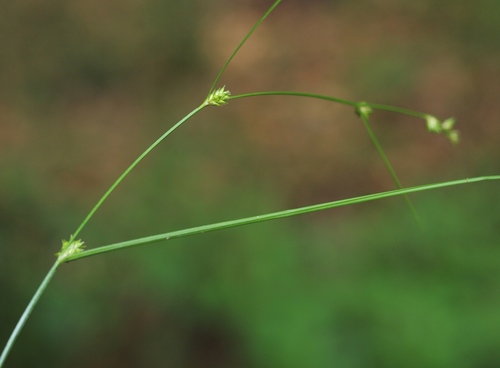
Remote Sedge
Carex remota
Elegant, arching, and perfectly suited for the shadows, the Remote Sedge is a masterpiece of woodland architecture. Its unique, widely spaced flowers and fountain-like form make it a favorite for both garden designers and the tiny creatures that hide beneath its leaves.
Quick Identification
Size
Grows in dense tufts 30–60 cm (12–24 inches) tall; leaves are very narrow, typically 1.5–3 mm wide.
Colors
Bright to pale green foliage; flowering spikes are light green turning to a soft golden-brown as they mature.
Key Features
- Widely spaced (remote) flowering spikes along the upper stem
- Long, leaf-like bracts that significantly exceed the length of the flower head
- Slender, arching stems that give the plant a weeping, fountain-like appearance
- Densely tufted growth habit without spreading runners
When You’ll See Them
Behavior
Remote Sedge is a perennial plant that behaves as a fundamental structural element in damp, shaded ecosystems. Unlike many other sedges that spread via aggressive underground rhizomes, Remote Sedge grows in polite, tight clumps (caespitose habit). It spends the early spring pushing out fresh, bright green growth, followed by the appearance of its distinctive flowering stems in late spring. It is a specialist of 'stagnant' or slow-moving water environments and heavy shade where other grasses might struggle.
In the backyard ecosystem, Remote Sedge acts as a high-quality shelter provider. Its dense, arching leaves create a 'skirt' around the base of the plant, providing a humid microclimate that is essential for amphibians like frogs and newts, as well as various ground-dwelling invertebrates. While it doesn't 'interact' with humans in a traditional sense, it is highly valued in rain gardens and wildlife-friendly landscaping for its ability to stabilize soil in wet areas and provide year-round texture.
EverydayEarth exclusive
Camera Tips
To capture the delicate beauty of Remote Sedge, position your camera at a low 'worm’s-eye' view. This angle emphasizes the fountain-like arch of the leaves and allows you to see the unique spacing of the flower spikes against the sky or a darker woodland background. Because the stems are slender and move easily in the breeze, use a camera with a fast shutter speed or a 'pet' mode to avoid motion blur during windy days. If you are using an AI-powered camera like a Bird Buddy or a trail cam, place it 1–2 feet away from the clump to capture the small birds and mammals that frequently visit the plant for cover.
Since Remote Sedge is a hub for biodiversity, it is an excellent 'station' for your camera. We recommend setting the camera's motion sensitivity to high, as the small movements of a frog or a ground-beetle scurrying through the base of the sedge might not trigger lower settings. If your camera has a macro lens attachment, the flowering spikes (inflorescences) make for stunning close-up shots between May and July, revealing the intricate scales and perigynia that are often missed by the naked eye.
Consider the lighting carefully; Remote Sedge lives in the shade, which can lead to grainy images. If possible, place your camera so that it catches filtered 'dappled' sunlight during the early morning hours (6–9 AM). This creates high-contrast highlights on the pale green leaves that look spectacular on film. In the winter, the plant remains semi-evergreen, providing a rare splash of color for your trail cam feed when the rest of the garden is dormant and brown.
Similar Species
Species that look similar or are commonly confused with Remote Sedge.
Frequently Asked Questions
Record Remote Sedge at your habitat
Connect a camera to start building your own species record — AI identifies every visitor automatically.