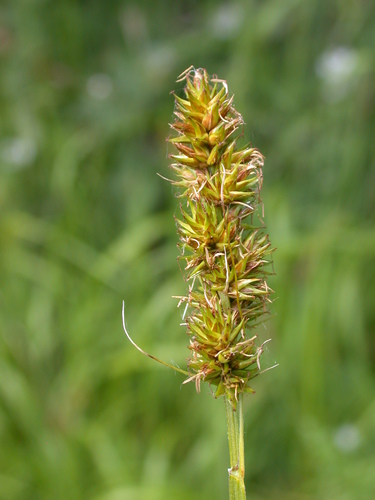
False Fox-sedge
Carex otrubae
A hardy and architectural gem of the wetlands, the False Fox-sedge offers dense cover for small creatures and striking 'fox-tail' spikes that brighten any damp corner of the garden.
Quick Identification
Size
Stems typically reach 30–100 cm (12–40 inches) in height; flower spikes are 3–7 cm (1.2–2.8 inches) long.
Colors
Bright green foliage; yellowish-brown flower heads; distinctive whitish or translucent leaf sheaths.
Key Features
- Sharply triangular stems with slightly winged edges
- Densely tufted growth habit without runners
- Flower spikes clustered at the top resembling a bushy tail
- Long, pointed ligules where the leaf meets the stem
When You’ll See Them
Behavior
False Fox-sedge is a perennial, clump-forming plant that plays a vital structural role in wetland ecosystems. Unlike many other sedges that spread aggressively via underground rhizomes, this species grows in tidy, dense tufts. This architectural habit provides consistent, year-round architecture in damp areas, making it a favorite for sustainable rain gardens and pond margins.
While it doesn't move like an animal, it is highly responsive to the seasons, pushing up vibrant green shoots in early spring and producing its iconic 'fox-tail' seed heads by mid-summer. In the wild, it acts as a 'nursery' plant, providing sheltered micro-climates at its base for damp-loving invertebrates and small amphibians. It is also an important soil stabilizer, using its deep root system to hold onto banks in drainage ditches and canals.
EverydayEarth exclusive
Camera Tips
Capturing the False Fox-sedge on your backyard camera is less about catching the plant in motion and more about using it as a biological 'stage' for other wildlife. To get the best results, mount your camera at a very low angle—no more than 12 inches off the ground. Aim the lens through the base of the sedge clumps. This 'mouse-eye view' often reveals the hidden tunnels used by voles, shrews, and frogs who use the dense, overhanging leaves of the False Fox-sedge as protection from aerial predators.
Because this species thrives in high-humidity environments like pond edges and ditches, moisture management is key. Use a camera housing with a high IP rating and place a few silica gel desiccant packets inside the battery compartment to prevent the lens from fogging during early morning temperature shifts. If you want to capture the plant's stunning reproductive cycle, use a time-lapse setting. A single photo taken every 4 to 6 hours from May through June will beautifully document the 'fox-tail' spikes as they emerge and transition from green to golden-brown.
Technically, sedges can be tricky for motion-activated cameras because their long leaves sway in the breeze, which can lead to hundreds of empty 'false trigger' videos. To combat this, lower your camera's PIR (Passive Infrared) sensitivity or use a hybrid mode that combines a slow time-lapse with motion detection. If your camera allows for exposure adjustments, set it to -0.3 EV. The bright, whitish leaf sheaths of the False Fox-sedge can sometimes be overexposed in direct sunlight, and a slightly darker setting will preserve the intricate textures of the stems and seeds.
Similar Species
Species that look similar or are commonly confused with False Fox-sedge.
Frequently Asked Questions
Record False Fox-sedge at your habitat
Connect a camera to start building your own species record — AI identifies every visitor automatically.