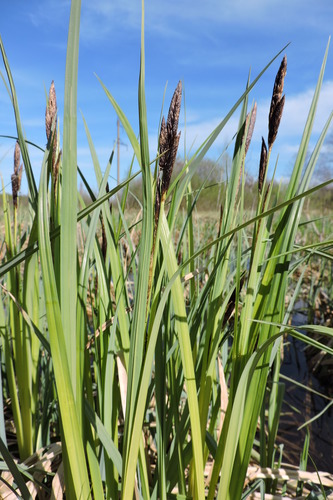
Greater Pond-sedge
Carex riparia
A towering titan of the wetlands, the Greater Pond-sedge is easily recognized by its sharp triangular stems and stunning blue-green foliage. As Britain's largest sedge, it creates a thriving aquatic jungle that serves as a vital sanctuary for your backyard's most elusive water-dwellers.
Quick Identification
Size
Height up to 130 cm (51 inches); leaf length up to 160 cm (63 inches); leaf width 6–20 mm (0.2–0.8 inches).
Colors
Glaucous blue-green foliage; chocolate-brown male flowering spikes; olive-green female spikes that mature to dark brown.
Key Features
- Stout, sharply triangular stems that feel rough to the touch
- Broad, waxy blue-green (glaucous) leaves with prominent cross-veins
- Large, sausage-shaped flower spikes
- Britain's largest native sedge species
When You’ll See Them
Behavior
Greater Pond-sedge is a vigorous perennial that defines the architecture of many wetland ecosystems. Unlike many grasses that grow in isolated tufts, this species spreads via a network of thick, underground rhizomes to form dense colonies known as sedge-beds. These beds act as natural filters for water systems and provide essential structural stability to soft riverbanks and pond edges.
During the spring, the plant undergoes a rapid growth spurt, sending up its iconic triangular stems topped with distinct flowering structures. It is wind-pollinated, with the dark male spikes at the top releasing clouds of yellow pollen to reach the female spikes lower down. For the backyard enthusiast, this plant acts as a 'nursery' for wildlife, offering sheltered corridors for amphibians and nesting material for waterfowl.
EverydayEarth exclusive
Camera Tips
Capturing the Greater Pond-sedge on an AI-powered camera requires a slightly different approach than tracking moving animals. Since many AI models are designed to ignore 'background' vegetation, you should focus your camera on the interactions that happen within the sedge-bed. Position your camera at a low angle, roughly 30 cm (12 inches) from the ground, to capture frogs, newts, and water voles that use the dense base of the sedge as a highway. The blue-green glaucous leaves provide a high-contrast backdrop that makes the colors of visiting wildlife pop.
If your camera supports time-lapse mode, this is the ultimate way to document the life cycle of Greater Pond-sedge. Set a schedule to take one photo every four hours starting in early March. By July, you will have a spectacular video showing the 'architectural' rise of the stems and the heavy bowing of the seed heads. To avoid 'false triggers' caused by the leaves swaying in the wind, use the 'activity zone' or 'masking' features in your camera settings to exclude the upper, most flexible parts of the leaves from the motion-detection area.
During the summer flowering peak, aim your camera at the dark male spikes to catch dragonflies and damselflies using them as hunting perches. The rigid stems are the perfect stable platform for these insects. In the winter, keep the camera rolling; though the plant turns golden-brown and dies back, the seed heads remain a magnet for small birds like siskins and redpolls. Ensure your camera is tilted slightly downward to avoid lens flare from the sun, which sits lower in the sky during the peak winter months when the sedge's skeletal structure is most visible.
Similar Species
Species that look similar or are commonly confused with Greater Pond-sedge.
Frequently Asked Questions
Record Greater Pond-sedge at your habitat
Connect a camera to start building your own species record — AI identifies every visitor automatically.