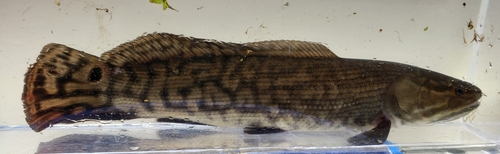
Eyetail Bowfin
Amia ocellicauda
A prehistoric survivor with a striking 'eye' on its tail, the Eyetail Bowfin is a master of the North American shallows. Often called a 'living fossil,' this resilient predator can breathe air and fiercely protects its young in the weedy backwaters of the Great Lakes and beyond.
Quick Identification
Size
18–35 inches (45–90 cm) in length; typically 2–10 lbs (1–4.5 kg), though large females can exceed 15 lbs
Colors
Mottled olive-green to brown back and sides with a pale cream or yellow belly; males feature a vivid black eyespot ringed in bright orange or yellow on the upper tail base.
Key Features
- Long, ribbon-like dorsal fin extending over half the body length
- Prominent black eyespot (ocellus) at the base of the tail
- Large bony gular plate located between the lower jaws
- Tubular nostrils and a prehistoric, cylindrical body shape
When You’ll See Them
Geographic range
Where Does the Eyetail Bowfin Live?
The Eyetail Bowfin is native to the freshwater ecosystems of North America, where it occupies a significant portion of the eastern and central regions. Its core range extends from the Great Lakes and the St. Lawrence River basin down through the Atlantic coastal plain and into the upper Mississippi River drainage. While it is most frequently encountered in the United States, its range reaches northward into southeastern Canada, particularly around the shores of Lake Huron and Lake Ontario. Within these regions, it is a resident species, favoring the shallow, heavily vegetated margins of permanent water bodies.
Basemap © OpenStreetMap contributors
Behavior
The Eyetail Bowfin is a true "living fossil," representing a lineage of fish that has remained relatively unchanged for millions of years. They are renowned for their ability to breathe atmospheric air using a vascularized swim bladder, which allows them to survive in stagnant, low-oxygen waters where other fish would perish. This physiological quirk often leads to them being seen gulping air at the surface in backyard ponds or slow-moving creeks.
These fish are solitary and highly territorial ambush predators. During the spring spawning season, their behavior becomes particularly fascinating; the males take on a vibrant emerald hue and become dedicated parents. They clear a circular nest in the vegetation and fiercely guard the eggs and the subsequent swarm of jet-black fry for several weeks, attacking anything—including much larger fish or even curious lures—that ventures too close.
EverydayEarth exclusive
Camera Tips
Capturing the Eyetail Bowfin on a backyard or trail camera requires a specialized approach since they are almost exclusively aquatic. If your property borders a shallow, weedy shoreline or a swampy inlet, the best strategy is to use a waterproof action camera or an underwater housing mounted to a weighted base. Position the camera in roughly 12 to 24 inches of water near the edges of lily pads or submerged logs, which serve as natural corridors for these ambush predators.
During the spring spawning season, look for "nests"—clear circular patches in the silt or vegetation. If you find one, place your camera nearby at a 45-degree angle to the nest. Male Eyetail Bowfin are highly active during this time and will remain in the frame for long periods as they guard their offspring. Avoid placing the camera directly in the nest to prevent disturbing the eggs. Natural lighting is best, so aim for shallow water where sunlight can penetrate, but if your camera has infrared capabilities, you can capture their mysterious nocturnal foraging runs.
For those using cameras mounted above the water, look for clear, still days. Polarized filters are essential to cut through surface glare and reveal the fish below. Set your camera on a pier or a low-hanging branch overlooking a shallow flat. Bowfin frequently surface to gulp air, so a high-frame-rate setting can help you catch that split-second 'breathing' behavior. Using a slow-release fish-based attractant nearby can help keep them in the frame, but ensure it is secured so they don't swim off with the lure!
Similar Species
Species that look similar or are commonly confused with Eyetail Bowfin.
Frequently Asked Questions
Record Eyetail Bowfin at your habitat
Connect a camera to start building your own species record — AI identifies every visitor automatically.