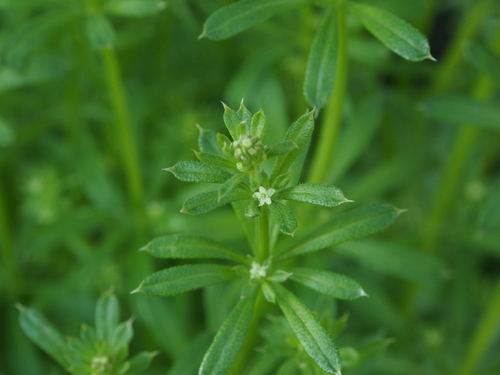
False Cleavers
Galium spurium
A master hitchhiker and expert climber, False Cleavers uses thousands of tiny hooks to scramble over its neighbors. This resilient 'stickwilly' is a fascinating example of botanical engineering in your own backyard.
Quick Identification
Size
30 to 150 cm (1 to 5 feet) in length; stems are thin but can form dense mats.
Colors
Bright light green foliage; tiny flowers are greenish-white to pale yellow.
Key Features
- Square stems covered in tiny, backward-pointing hooked bristles
- Leaves arranged in whorls of 6 to 8 along the stem
- Small, 4-petaled greenish-white flowers
- Climbing or scrambling growth habit using other plants for support
- Smooth or slightly bristly twin-lobed fruit
When You’ll See Them
Geographic range
Where Does the False Cleavers Live?
False Cleavers is native to a massive geographic area spanning temperate Europe, North Africa, and much of Asia. It has successfully expanded its reach into North America, where it is widespread across Canadian provinces and several northern U.S. states, and it is also established as an introduced species in Australia. This plant is a specialist of the 'Old World' that has become a global traveler due to its highly effective seed-hitching capabilities.
Basemap © OpenStreetMap contributors
Behavior
False Cleavers is a fascinating annual plant known for its "scrambling" behavior. Rather than growing a strong, woody trunk, it uses hundreds of tiny, Velcro-like hooks to hitch a ride on neighboring vegetation, fences, or even your pet's fur. This allows it to climb toward the sunlight with minimal energy expenditure. It is a master of opportunism, often appearing suddenly in disturbed soil where it can quickly dominate a small patch of ground by forming a tangled, sticky mat.
While often dismissed as a weed, its behavior is a perfect example of plant adaptation. It interacts with the animal world primarily through seed dispersal; its small, round fruits are also covered in hooks, ensuring they travel far and wide by sticking to passing mammals or human clothing. In a garden or backyard setting, it serves as a host for various small insects, though its aggressive growth can sometimes overwhelm more delicate ornamental plants.
EverydayEarth exclusive
Camera Tips
To capture the growth of False Cleavers, set your camera to time-lapse mode rather than motion-trigger. Because the plant’s movement is slow to the human eye, taking one photo every hour during daylight will allow you to create a stunning video of the plant 'crawling' up a fence or neighboring plant. Position your camera on a tripod about 1 to 2 feet from the ground, focusing on a young shoot in early spring.
If you are interested in the micro-world, use a camera with a good macro or close-focus capability. The hooked bristles that give the plant its 'sticky' reputation are best seen when back-lit by the early morning or late afternoon sun. Angle your camera so the sun is behind the plant; this will make the tiny hairs glow and stand out against the background, highlighting its unique physical adaptations.
For those using motion-activated trail cams, False Cleavers is an excellent 'background' plant to monitor insect activity. Place the camera at the same height as the flower whorls. Use a high-sensitivity setting and a fast shutter speed to capture the tiny hoverflies and solitary bees that are attracted to the plant's inconspicuous flowers. Avoid placing the camera in a spot where long grass will blow in front of the lens, as this will result in thousands of 'false' triggers on windy days.
Similar Species
Species that look similar or are commonly confused with False Cleavers.
Frequently Asked Questions
Record False Cleavers at your habitat
Connect a camera to start building your own species record — AI identifies every visitor automatically.