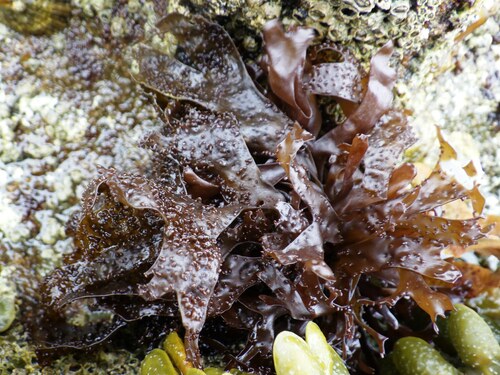
false Irish moss
Mastocarpus stellatus
Often called the 'Turkish Towel' of the sea, false Irish moss is a resilient red alga that thrives in the crashing waves of the North Atlantic. Its unique bumpy texture and deep purple hues make it a fascinating subject for any coastal nature enthusiast.
Quick Identification
Size
5-15 cm (2-6 inches) in length; fronds typically 1-3 cm (0.4-1.2 inches) wide
Colors
Deep reddish-purple to dark brownish-black; can bleach to greenish-yellow in high summer sun
Key Features
- Channelled or 'u-shaped' fronds with curled edges
- Distinctive bumpy surface covered in small papillae (Turkish towel texture)
- Thick, leathery consistency that becomes brittle when dry
When You’ll See Them
Behavior
False Irish moss is a master of the intertidal zone, having evolved to survive the extreme stress of being repeatedly submerged and dried out. Unlike many other seaweeds that collapse into a heap when the tide recedes, this species maintains its structure and uses its channelled fronds to trap moisture. It is a slow-growing perennial that can live for several years, firmly anchoring itself to rocks using a discoid holdfast that resists the pulling force of crashing Atlantic waves.
While it may appear stationary, it is dynamic in its response to the environment. During periods of high light or low nutrients, the seaweed changes its pigment concentration, shifting from a deep, royal purple to a pale green. It also serves as a critical nursery habitat for tiny marine invertebrates, providing shade and protection from predators during low tide. Its relationship with humans is long-standing, often harvested alongside true Irish moss for its thicking properties and medicinal folk-remedies.
EverydayEarth exclusive
Camera Tips
Capturing the beauty of false Irish moss requires a different strategy than photographing mobile wildlife. Because this species is found in the intertidal zone, your primary concern is the tide schedule. The best time to set up your camera is during a receding tide, about an hour before low tide. This allows you to position your equipment in areas that are usually underwater. Use a weighted, low-profile tripod or a specialized rock clamp to ensure your camera doesn't get swept away by a rogue wave. Aim for a 45-degree angle to highlight the 'Turkish towel' texture of the papillae, which is the species' most defining visual characteristic.
Lighting is crucial for bringing out the deep purples of the fronds. Direct midday sun can cause harsh reflections on the wet surfaces, washing out the color. For the best results, use a polarizing filter to cut the glare and wait for overcast conditions or the soft light of early morning. If your camera setup allows for macro photography, get as close as possible. The intricate, bumpy surface of the fronds provides incredible abstract patterns that are invisible from a distance. If you are using an AI-triggered camera, set it to time-lapse mode rather than motion detection, as the slow growth of the algae won't trigger standard sensors.
A time-lapse over a 6-hour period is the most rewarding way to document this species. By taking a photo every 30 seconds, you can create a video that shows the seaweed 'coming to life' as the tide returns. You’ll see the dried, shriveled fronds rapidly expand and begin to dance gracefully in the current. Additionally, keep an eye on the 'bycatch' of your photos; false Irish moss is a hub for small crabs, sea snails, and amphipods. If you use a waterproof housing and submerge your camera in a tide pool, you can capture the interactions between these creatures and the moss, providing a complete picture of this mini-ecosystem.
Finally, always prioritize safety and equipment care. Saltwater is extremely corrosive to electronics. After your session, even if your camera is in a 'waterproof' case, wipe down all gear with a cloth dampened with fresh water. Be mindful of your surroundings; rocky shores can be slippery and the tide can come in faster than expected. Position your camera in a location that is accessible but secure, and always check the local tide tables before heading out to ensure you have enough time to set up and retrieve your gear safely.
Similar Species
Species that look similar or are commonly confused with false Irish moss.
Frequently Asked Questions
Record false Irish moss at your habitat
Connect a camera to start building your own species record — AI identifies every visitor automatically.