Irish Moss
Chondrus crispus
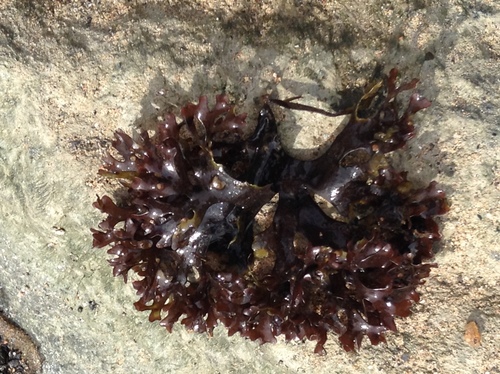
The resilient jewel of the Atlantic shore, Irish Moss transforms rocky coastlines into iridescent underwater forests. This remarkable red alga is more than just a sea plant; it's a vital anchor for coastal ecosystems and a master of survival in the crashing surf.
Quick Identification
Size
Fronds typically reach 5–15 cm (2–6 inches) in length, with a spread of up to 10 cm (4 inches).
Colors
Highly variable; ranges from greenish-yellow in bright sun to deep burgundy, reddish-purple, or dark purplish-brown in deeper water.
Key Features
- Fan-like, dichotomously branched fronds
- Deep purple to greenish-yellow coloration
- Rubbery, cartilaginous texture
- Discoid holdfast for rock attachment
- Visible blue-violet iridescence when submerged
When You’ll See Them
Behavior
While stationary, Irish Moss is highly responsive to its environment. Its color is a direct reflection of its 'behavioral' adaptation to light intensity—a process known as chromatic adaptation. In shallow, sun-drenched tide pools, the moss may bleach to a pale yellow-green to protect itself from UV damage, while specimens in deeper, shaded crevices maintain a rich, dark pigment to maximize light absorption for photosynthesis.
EverydayEarth exclusive
Camera Tips
To capture high-quality footage of Irish Moss in its natural 'backyard'—the coastal tide pool—you will need a waterproof action camera or a trail camera with a high IP (Ingress Protection) rating. The most compelling shots are achieved by submerging the camera inside a stable tide pool during the transition from low to high tide. Use a weighted base or a heavy-duty suction mount to secure the camera to a flat rock. Setting your camera to time-lapse mode, with one frame every 30 seconds, will allow you to capture the mesmerizing 'dance' of the fronds as the incoming tide creates a surge, showcasing the plant's incredible flexibility.
Lighting is the secret to revealing the moss's hidden beauty. To document the stunning blue-violet iridescence often found at the tips of the fronds, aim for a window of time when the sun is directly overhead (usually 11 AM to 2 PM). This high-angle light penetrates the water and hits the specialized layers of the cell walls, creating a shimmering effect that is invisible on dry specimens. If your camera allows for macro settings, position the lens within 3-5 inches of a healthy clump to showcase the intricate 'Y' shaped branching patterns that distinguish this species from other seaweeds. Avoid using an internal flash, as it will likely create harsh glares on the wet, rubbery surface of the algae.
For those monitoring coastal wildlife, Irish Moss serves as an excellent 'stage' for capturing interactions. Place your camera facing a dense patch of moss and leave it for a full tide cycle. You will likely record small crustaceans like scuds or shore crabs emerging from the safety of the fronds to forage. If your backyard camera is situated on a pier or a rocky jetty, consider a 'top-down' angle during a very low tide to capture the expansive, carpet-like mats. In the winter, keep your camera lens clear of salt spray, as dried salt crystals will blur the image; a quick wipe with a damp microfiber cloth between tide cycles is essential for crisp, professional-grade results.
Similar Species
Species that look similar or are commonly confused with Irish Moss.
False Irish Moss
Features rough, bumpy 'papillae' on the surface of the fronds, whereas true Irish Moss is smooth.
Dulse
Has much larger, wider, leaf-like fronds that lack the repeated 'Y' branching of Irish Moss.
Sea Lettuce
A bright green alga with translucent, paper-thin sheets rather than the thick, cartilaginous purple fronds of Irish Moss.
Frequently Asked Questions
Record Irish Moss at your habitat
Connect a camera to start building your own species record — AI identifies every visitor automatically.