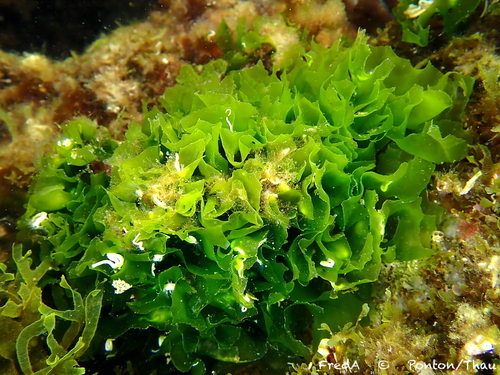
Sea Lettuce
Ulva rigida
The emerald of the intertidal zone, Sea Lettuce is a vibrant, translucent seaweed that turns rocky shorelines into lush underwater meadows. Thriving on sunlight and coastal nutrients, it is a vital indicator of the health of our local marine 'backyards.'
Quick Identification
Size
Fronds typically range from 10 to 50 cm (4 to 20 inches) in length, though they can reach up to 1 meter (40 inches) in nutrient-rich waters.
Colors
Vibrant emerald green to deep grass green; often translucent when held up to the light.
Key Features
- Translucent, leaf-like fronds that are only two cells thick
- Stiff, leathery texture near the attachment base
- Ruffled or undulating edges along the margins
- Often found growing in dense, vibrant green mats
When You’ll See Them
Behavior
Sea Lettuce (Ulva rigida) is a fascinating marine macroalgae that behaves as the 'lungs' of the shoreline. While it is sessile, meaning it anchors itself to rocks, shells, or pilings using a small disc-like holdfast, it is incredibly dynamic. It thrives in eutrophic environments—areas rich in nutrients—which often makes it a common sight near suburban coastlines where garden runoff meets the sea. It grows rapidly during the sunny months, utilizing photosynthesis to produce oxygen and biomass.
In the backyard coastal ecosystem, Sea Lettuce serves as both a grocery store and a nursery. It doesn't move on its own, but its fronds sway rhythmically with the pulse of the tides, providing a protective canopy for small crustaceans, snails, and juvenile fish. During low tide, it has the remarkable ability to survive partial desiccation, clinging to wet rocks and waiting for the return of the tide to rehydrate and continue its growth cycle.
EverydayEarth exclusive
Camera Tips
To capture the ethereal beauty of Sea Lettuce, you need to think like a marine photographer. Because this species is submerged or semi-submerged, an action camera with a waterproof housing is your best tool. Use a weighted tripod or a 'gorilla-pod' style mount to secure your camera at the bottom of a tide pool. Angle the lens slightly upward toward the water's surface; this allows the sun to back-light the translucent green fronds, making them glow intensely green against the darker water.
Timing is everything when filming Sea Lettuce. The most dramatic footage is captured during the 'transition tides'—the hour before and after high tide. As the water rushes back into the pools, the Sea Lettuce comes alive, dancing and swirling in the current. Use a high frame rate (60fps or higher) if you want to create beautiful slow-motion sequences of this movement. Alternatively, a time-lapse set to one frame every 10 seconds over a full tidal cycle can reveal how the plant collapses and expands as the water levels change.
If you are using an AI-powered camera to detect movement, be aware that the constant swaying of the fronds might trigger the sensor frequently. To get the best 'wildlife' shots, place your camera so that the Sea Lettuce fills the lower third of the frame. This setup often catches the creatures that live within it—watch for the movement of shore crabs, sea slugs, and small blennies that use the lettuce as camouflage. The bright green color of the Ulva rigida provides a perfect high-contrast background for these darker-colored animals.
Maintenance is the final key to success. Saltwater is harsh on equipment and can leave crusty white residues on your lens port, blurring your shots. Rinse your camera housing in fresh water after every session. If you are doing a long-term deployment in a backyard saltwater pond or a sheltered cove, check the lens every two days for 'biofouling'—small organisms or silt that might settle on the glass and obscure the vibrant green of your subject.
Similar Species
Species that look similar or are commonly confused with Sea Lettuce.
Frequently Asked Questions
Record Sea Lettuce at your habitat
Connect a camera to start building your own species record — AI identifies every visitor automatically.