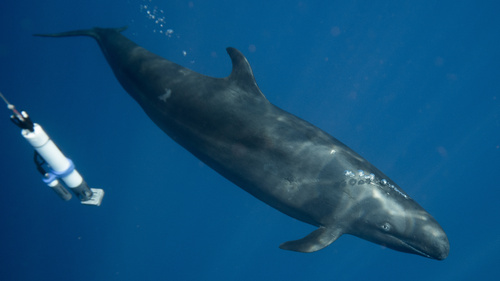
False Killer Whale
Pseudorca crassidens
A sleek, social, and highly intelligent oceanic dolphin, the false killer whale is one of the deep sea's most energetic predators. Known for their acrobatic leaps and unique food-sharing culture, they are a rare and thrilling sight for any marine enthusiast.
Quick Identification
Size
4.3 to 6 metres (14–20 ft) in length; weighing 1,100 to 2,200 kg (2,400–4,850 lbs)
Colors
Uniformly dark grey to black body; subtle light grey 'anchor' marking on the chest; no white patches
Key Features
- Long, slender body with no visible beak
- Small, sickle-shaped dorsal fin set mid-back
- Pectoral flippers have a distinctive 'elbow' or S-curve
- Rounded, bulbous forehead
When You’ll See Them
Geographic range
Where Does the False Killer Whale Live?
False killer whales are found across the globe in tropical and warm-temperate waters. They are native to all major oceans, with a range that typically stays between 45°N and 45°S. While they are primarily nomads of the high seas, core populations are frequently encountered near oceanic archipelagos such as Hawaii, the Galapagos, and the Caribbean islands, as well as along the continental shelves of Australia and Brazil. Because they follow migratory fish, they do not stay in one place for long, making every sighting a special event.
Basemap © OpenStreetMap contributors
Behavior
In the wild, they are curious and often approach boats, though they have developed a reputation among fishermen as 'clever thieves' for their ability to delicately remove fish from longline hooks. Despite their name, they are not particularly aggressive toward humans, but they are top-tier predators that have been known to hunt other small cetaceans. Their vocalizations are complex, consisting of a wide range of clicks, whistles, and pulses used for both navigation and social bonding.
EverydayEarth exclusive
Camera Tips
Placement is critical. If you are in an area where they are known to frequent, such as near a steep underwater drop-off, use a towed underwater camera array or a 'drop-cam' weighted to stay steady at shallow depths. They are often attracted to the bubbles and pressure waves of boat wakes, so mounting a camera at the stern (back) of your boat facing the wake is a prime spot to catch them bow-riding or jumping. Use a polarizing filter if shooting from above the surface to cut down on water reflection and see their dark forms more clearly beneath the waves.
Since false killer whales are highly vocal, combining your video setup with a hydrophone (underwater microphone) is a game-changer. Their clicks and whistles can often be heard before they are seen, providing an acoustic trigger for your recording. In terms of timing, focus your efforts during the migration seasons of their favorite prey, like mahi-mahi or tuna. Always ensure your camera is set to a wide-angle lens to capture the full scale of their 20-foot bodies as they pass close to the lens.
Similar Species
Species that look similar or are commonly confused with False Killer Whale.
Frequently Asked Questions
Record False Killer Whale at your habitat
Connect a camera to start building your own species record — AI identifies every visitor automatically.