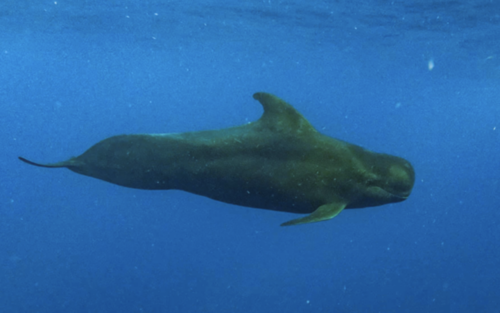
Short-finned Pilot Whale
Globicephala macrorhynchus
The 'cheetah of the deep' is a master of the open ocean, known for its incredible diving speed and unbreakable family bonds. With their distinctive bulbous heads and social nature, these whales are a majestic sight for any oceanic observer.
Quick Identification
Size
3.7 to 7.2 meters (12 to 24 feet) in length; weights range from 1,000 to 3,600 kg (2,200 to 8,000 lbs)
Colors
Dark gray to brownish-black; features a light gray 'saddle' patch behind the dorsal fin and a pale anchor-shaped patch on the chest.
Key Features
- Large bulbous forehead or 'melon'
- Broad-based, sickle-shaped dorsal fin set far forward on the body
- Short, barely-discernible beak
- Long pectoral fins measuring about 1/5th of body length
When You’ll See Them
Geographic range
Where Does the Short-finned Pilot Whale Live?
The Short-finned Pilot Whale is a cosmopolitan species that thrives in the tropical and warm-temperate waters of the world's oceans. They are native to the Atlantic, Pacific, and Indian Oceans, typically restricted to the band between 41°N and 33°S. You can find them frequently off the coasts of the Hawaiian Islands, the Canary Islands, Japan, and the southeastern United States, where deep water is accessible close to shore.
Basemap © OpenStreetMap contributors
Behavior
Short-finned Pilot Whales are exceptionally social animals that live in stable, matrilineal pods. These groups typically consist of 15 to 30 individuals, though 'super-pods' of several hundred are sometimes observed during travel or mating. Their social bonds are incredibly strong; they are known to babysit each other's calves and, unfortunately, their refusal to abandon a distressed leader often leads to mass strandings.
Often referred to as the 'cheetahs of the deep,' these whales are capable of high-speed sprints at depths of nearly 1,000 meters to hunt squid. At the surface, they are frequently seen 'logging'—floating horizontally and motionlessly in a group to rest. While they aren't as acrobatic as some smaller dolphin species, they do occasionally spy-hop, breach, or slap their tails (lobtailing) against the water's surface.
EverydayEarth exclusive
Camera Tips
Capturing Short-finned Pilot Whales requires a specialized approach since they are rarely visible from the backyard unless you live on a cliffside overlooking a deep-water channel. For those with coastal properties or boat access, a drone-mounted camera is the gold standard. Use a circular polarizing filter to cut through surface glare, which allows the camera to see the whale's entire silhouette and the distinctive light 'saddle' patch behind the dorsal fin even when they are slightly submerged.
If you are setting up a stationary trail camera from a high vantage point like a pier or balcony, use a telephoto lens with a motion-trigger area focused on the 'break' where the deep ocean meets the shelf. Because whales move relatively slowly when logging at the surface but can disappear quickly, set your camera to 'Burst Mode' or high-frame-rate video (at least 60fps). This ensures you capture the moment the blowhole clears the water or the fluke rises before a dive.
For water-based setups, action cameras mounted on a boat hull can capture underwater vocalizations and social interactions if the water is clear. Use a fast shutter speed (1/1000s or higher) to freeze the action of splashing water or the fine details of their skin texture. Since they are often active in the bright midday sun, keep your ISO low to avoid grain and preserve the deep black tones of their skin.
Similar Species
Species that look similar or are commonly confused with Short-finned Pilot Whale.
Long-finned Pilot Whale
Found in much colder waters; has significantly longer, elbowed pectoral fins and more teeth.
False Killer Whale
More slender body with a much smaller, more pointed dorsal fin and a less bulbous head.
Risso's Dolphin
Smaller with a distinctively scarred gray body and a more prominent vertical crease in the forehead.
Frequently Asked Questions
Record Short-finned Pilot Whale at your habitat
Connect a camera to start building your own species record — AI identifies every visitor automatically.