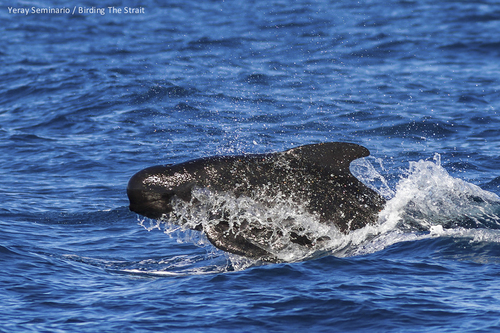
Long-finned Pilot Whale
Globicephala melas
A social masterpiece of the deep, the Long-finned Pilot Whale is easily identified by its bulbous 'pothead' and incredible family bonds. These intelligent nomadic travelers roam the world's coldest oceans in tight-knit pods.
Quick Identification
Size
Length of 3.7–6.7 m (12–22 ft); weight of 1,300–2,300 kg (2,900–5,000 lb)
Colors
Primarily jet black to dark charcoal gray; features a light gray 'saddle patch' behind the dorsal fin and a pale, anchor-shaped mark on the throat and chest.
Key Features
- Extremely bulbous forehead called a 'melon'
- Unusually long, sickle-shaped pectoral fins
- Broad-based dorsal fin located far forward on the back
- Stocky, powerful body with a thick tail stock
When You’ll See Them
Geographic range
Where Does the Long-finned Pilot Whale Live?
The Long-finned Pilot Whale is found in the cold-temperate and subpolar waters of the North Atlantic and throughout the Southern Ocean. In the Northern Hemisphere, they are native to the waters spanning from the United States and Canada across to the United Kingdom, Iceland, and Norway. In the Southern Hemisphere, they occupy a circumpolar range, frequently appearing near the coasts of Australia, New Zealand, South Africa, and southern South America. This species prefers deep pelagic environments but is often drawn toward the shore by the seasonal migrations of their primary prey, the squid.
Basemap © OpenStreetMap contributors
Behavior
Long-finned Pilot Whales are remarkably social marine mammals, living in highly stable matrilineal pods that function much like a family unit. These pods, which can number from 20 to over 100 individuals, are often led by an elder female. They are known as 'cheetahs of the deep' due to their ability to perform high-speed, deep-water sprints to hunt for squid at depths of up to 600 meters. Their social bonds are so intense that the entire pod will often follow a lead individual, a trait that unfortunately contributes to mass stranding events.
When at the surface, they are frequently observed 'logging' (floating motionless), spy-hopping to scan the horizon, or lobtailing by slapping their massive tails against the water. While generally shy of boats compared to smaller dolphins, they are intensely vocal, using a complex library of clicks, whistles, and pulsed calls to coordinate movements and maintain social ties. They rarely interact directly with humans in the wild but are often seen in the company of other cetaceans, such as Bottlenose Dolphins.
EverydayEarth exclusive
Camera Tips
Capturing the Long-finned Pilot Whale on camera requires a specialized approach since they are entirely aquatic. For those with 'ocean backyards' or coastal properties, the most effective setup is a shore-based AI camera mounted at a high elevation, such as a cliffside or balcony overlooking the sea. Use a telephoto lens with at least 300mm focal length and a polarising filter to cut through surface glare, which allows the AI to better detect the dark shapes and the white anchor markings as they surface to breathe.
If you are monitoring from a vessel or buoy, set your camera to a fast shutter speed (1/1000s or higher) to capture the rapid motion of a 'blow' or a breach. These whales are active through the night, so incorporating thermal imaging technology into your AI setup is the best way to detect their warm breath (blow) against the cold night air. AI models should be trained specifically on the profile of their distinct, forward-leaning dorsal fin to avoid false triggers from waves or other marine debris.
For the most consistent results, pair your camera with an underwater hydrophone. Long-finned Pilot Whales are extremely talkative, and their vocalizations can serve as a long-distance trigger, waking your camera system before the pod even reaches the surface. Since they often follow schools of squid, positioning your equipment near underwater canyons or shelf breaks where these prey congregate will significantly increase your chances of a successful 'capture'.
Similar Species
Species that look similar or are commonly confused with Long-finned Pilot Whale.
Frequently Asked Questions
Record Long-finned Pilot Whale at your habitat
Connect a camera to start building your own species record — AI identifies every visitor automatically.