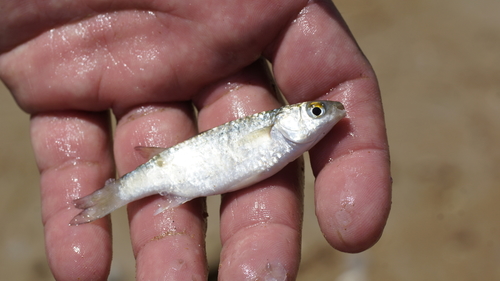
Fantail Mullet
Paramugil georgii
With its shimmering silver scales and iconic fan-shaped tail, the Fantail Mullet is the acrobatic star of Australia's coastal waterways. Watch them skip across the surface and explore the hidden life of our estuaries.
Quick Identification
Size
Typically 20–30 cm (8–12 inches) in length; maximum weight approximately 0.5 kg (1.1 lbs).
Colors
Bright silver flanks and belly with a olive-grey or brownish back. Fins are generally translucent to grey.
Key Features
- Distinctively large, fan-shaped caudal (tail) fin
- Small, pointed head with a terminal mouth
- Dark spot often visible at the base of the pectoral fin
- Deeply compressed body compared to other mullet species
When You’ll See Them
Geographic range
Where Does the Fantail Mullet Live?
The Fantail Mullet is native to the Oceania region, specifically found along the eastern and northern coasts of Australia. Its core range spans from the tropical waters of the Northern Territory and Queensland down through the temperate estuaries of New South Wales. Unlike some migratory fish, this species tends to remain within its local estuarine systems for its entire life cycle, favoring the sheltered waters of the continental shelf.
Basemap © OpenStreetMap contributors
Behavior
The Fantail Mullet is a highly social fish, typically found in large, coordinated schools. These schools navigate the shallow margins of estuaries and mangrove forests, moving with the tides to access rich feeding grounds. They are well known for their agility and a peculiar jumping behavior, where individuals leap clear of the water surface, likely to escape predators, clear their gills of silt, or simply move quickly over obstacles in shallow water.
In terms of interaction with humans, they are generally wary and will scatter quickly if they sense vibrations or sudden movements. However, they are a common sight for coastal residents living near canals or tidal creeks. They play a vital role in the ecosystem as 'ecological vacuums,' cleaning the substrate of organic matter and providing a primary food source for larger predatory fish and wading birds like herons and egrets.
EverydayEarth exclusive
Camera Tips
To capture high-quality footage of Fantail Mullet, you must account for the tidal nature of their habitat. If your property borders a canal or creek, mount your camera to a dock piling or a weighted tripod at a height that remains submerged during both low and high tides. Aim the lens at a 45-degree angle toward a sandy clearing between mangrove roots, as this is where the mullet often gather to sift through the sediment for food.
Mullet are not traditionally attracted to lures, but you can draw them into the camera's frame by using 'berley' or chum. A fine mixture of breadcrumbs, sand, and tuna oil creates a cloud of scent and particles that mimics a natural feeding opportunity. Place this attractant in a small mesh bag anchored directly in front of the lens. This will keep the school hovering in one spot, allowing your AI camera to trigger and record their social interactions.
For the best results, set your camera to a high frame rate (at least 60fps) to capture their rapid darting movements and the occasional jump. Lighting is key in murky estuarine water; try to position the camera so the sun is behind it, illuminating the silver scales of the fish. If using an AI-powered trail camera near the water's edge, ensure it is set to its highest sensitivity, as the silver flashes of the fish against a dark background are excellent triggers for motion sensors.
Regular maintenance is essential in saltwater environments. Check your camera every 3–4 days to wipe away algae or barnacle growth from the lens and sensors. Using a thin layer of specialized hydrophobic coating can help prevent salt crystals from blurring your shots once the tide recedes and the equipment is exposed to air.
Similar Species
Species that look similar or are commonly confused with Fantail Mullet.
Frequently Asked Questions
Record Fantail Mullet at your habitat
Connect a camera to start building your own species record — AI identifies every visitor automatically.