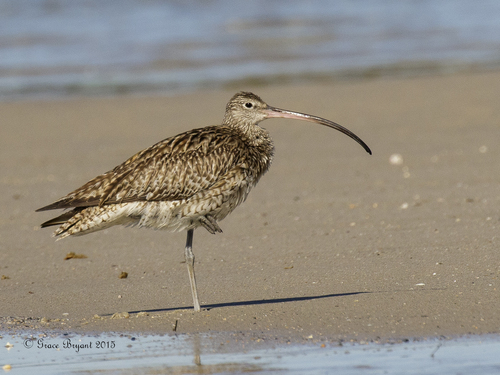
Far Eastern Curlew
Numenius madagascariensis
The Far Eastern Curlew is the world's largest sandpiper, an endangered giant of the wetlands famous for its incredible 10,000-mile migration. With a bill like a scimitar and a haunting coastal cry, it is one of the most spectacular sights for any backyard birdwatcher living near the shore.
Quick Identification
Size
60–66 cm (24–26 in) long with a 110 cm (43 in) wingspan; weighs 390–1,350 g (0.86–2.98 lb)
Colors
Buff-brown plumage with dark brown streaks; distinctive brown rump and unpatterned brown underwings; long, dark, downward-curving bill
Key Features
- World's largest sandpiper with a massive down-curved bill up to 20cm long
- Plain brown rump and lower back (unlike the white rump of the Eurasian Curlew)
- Uniformly brown-streaked underwing pattern
- Extremely long, blue-grey legs
When You’ll See Them
Geographic range
Where Does the Far Eastern Curlew Live?
Native to the Eastern Palearctic and Australasia, the Far Eastern Curlew is a globe-trotting icon of the East Asian-Australasian Flyway. Its breeding grounds are concentrated in the high latitudes of Northeastern Asia, including Russia, Mongolia, and Northern China. During the southern summer, these birds migrate thousands of miles to the coastal shores of Australia, New Zealand, Indonesia, and Papua New Guinea, where they rely on pristine intertidal wetlands to refuel and survive.
Basemap © OpenStreetMap contributors
Behavior
The Far Eastern Curlew is a master of the intertidal zone, known for its wary and cautious nature. During the non-breeding season, these birds are highly gregarious, often forming large roosting flocks at high tide, though they spread out individually to forage across mudflats as the water recedes. They are incredibly sensitive to human disturbance, often taking flight at the slightest sign of an intruder, making them a challenge to observe closely without a hidden camera.
As a long-distance migratory species, their life is dictated by the seasons and the tides. They spend their summers breeding in the marshes and bogs of Northern Asia before undertaking an epic journey across the East Asian-Australasian Flyway. Their distinctive, haunting 'shree-ree' call is a hallmark of the coastal wetlands where they spend the winter, serving as a social signal for others in the flock.
EverydayEarth exclusive
Camera Tips
Capturing the Far Eastern Curlew requires patience and strategic placement because of their extreme wariness. If you live near an estuary or coastal wetland, the best place for a camera is on the edge of a known 'high-tide roost'—the areas where the birds gather to wait out the high water. Position your camera low to the ground (about 12-18 inches) and aim it across the mudflat to capture their dramatic silhouette and long bills against the water's edge.
Timing is everything with this species. Use a camera with a programmable timer and set it to trigger during the hours surrounding low tide, when the birds are actively foraging. Because they move quickly while probing the mud, ensure your camera has a fast trigger speed and set it to 'burst mode' to capture the moment they pull a crab or worm from the ground. Avoid using bright white flashes at night; instead, rely on high-quality infrared sensors to avoid spooking the flock.
Since these birds are often found in salty, humid environments, ensure your camera housing is weather-sealed and wiped down regularly to prevent salt spray from obscuring the lens. You don't need traditional bait; the natural movement of crabs in the mud is the best lure. Instead, focus on finding a 'pinch point' like a narrow sand spit or a specific patch of mangroves where they frequently congregate to rest.
Similar Species
Species that look similar or are commonly confused with Far Eastern Curlew.
Eurasian Curlew
The Eurasian Curlew has a bright white rump and lower back, whereas the Far Eastern Curlew is solid brown in those areas.
Long-billed Curlew
A North American relative; the Far Eastern Curlew has more heavily streaked underwings and lacks the cinnamon-colored wing linings of the Long-billed species.
Frequently Asked Questions
Record Far Eastern Curlew at your habitat
Connect a camera to start building your own species record — AI identifies every visitor automatically.