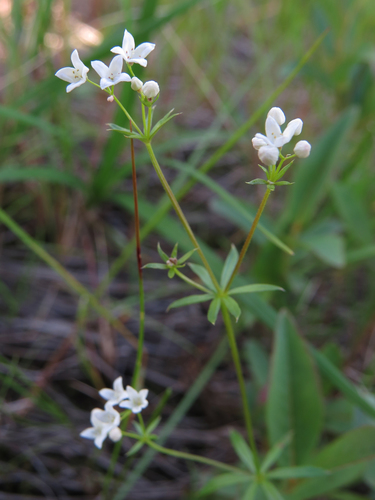
Fen Bedstraw
Galium uliginosum
A delicate, star-flowered scrambler that thrives in the dampest corners of the landscape. Fen Bedstraw brings an airy elegance to wetlands, weaving through grasses with its prickle-edged stems.
Quick Identification
Size
Height ranges from 10–60 cm (4–24 inches); flowers are tiny, roughly 2–3 mm (0.08–0.12 inches) in diameter.
Colors
Bright emerald green stems and leaves; tiny, star-shaped white flowers; small green fruits that turn brownish-black.
Key Features
- Square stems with downward-pointing prickles that feel rough to the touch
- Whorls of 6–8 narrow, needle-like leaves with a sharp point at the tip
- Clusters of small white, 4-petaled flowers
- Slender, scrambling growth habit that relies on surrounding vegetation for support
When You’ll See Them
Behavior
Fen Bedstraw is a delicate perennial herb known for its scrambling growth habit. Unlike climbing vines that use tendrils, it uses tiny, backward-pointing prickles on its square stems to 'hook' onto neighboring grasses and sedges. This allows it to weave through dense wetland vegetation to reach sunlight. It is a social plant in the ecological sense, often forming airy, tangled mats in damp environments.
While it may appear fragile, Fen Bedstraw is a vital part of the wetland ecosystem. It provides a micro-habitat for small invertebrates and serves as a nectar source for a variety of small-winged insects. In a backyard setting, its presence indicates high soil moisture and relatively undisturbed ground, often appearing in the 'wilder' damp corners of a garden or near a pond edge.
EverydayEarth exclusive
Camera Tips
To capture the delicate beauty of Fen Bedstraw, you need to think like a macro photographer. Because this plant is low-growing and slender, place your camera on a ground-level mount or a short tripod. Position the lens about 12–18 inches away from a healthy cluster of flower buds. If your camera has a macro mode or adjustable focus, ensure it is locked onto the leaf whorls, as the white flowers can easily 'wash out' in bright sunlight. To avoid overexposure, aim for a north-facing angle or place the camera in a spot that receives dappled light rather than harsh, direct midday sun.
Since plants don't move like animals, the best use of a trail camera here is the time-lapse function. Set your camera to take a photo every 15–30 minutes during the peak flowering months of June and July. This will allow you to see the 'scrambling' motion as the plant grows and the dramatic opening of the tiny white star-flowers. If you are using motion-trigger settings to catch visiting insects, set the sensitivity to high. The tiny hoverflies and solitary bees that visit Fen Bedstraw are small and fast, so a high shutter speed is essential to prevent motion blur.
One of the biggest challenges with Fen Bedstraw is wind. Because the stems are so thin, even a light breeze will send the plant dancing out of the frame, which can cause hundreds of 'false' triggers on a motion-sensing camera. To combat this, use a small garden stake or a 'Plamp' (a specialized horticultural clamp) to subtly steady the main stem just outside the camera's field of view. This keeps the flowers steady for the AI to identify while still allowing for natural movement.
Finally, consider the seasonal transition. As the flowers fade, Fen Bedstraw produces tiny, paired fruits. Keep your camera active into late August to capture the change from white blooms to green seeds. If you are lucky, your camera might even catch a glimpse of the small beetles and caterpillars that use the dense, tangled mats of Bedstraw as a nursery. For the best color saturation, check your camera settings and slightly bump up the contrast to make the bright green whorls pop against the darker wetland mud.
Similar Species
Species that look similar or are commonly confused with Fen Bedstraw.
Frequently Asked Questions
Record Fen Bedstraw at your habitat
Connect a camera to start building your own species record — AI identifies every visitor automatically.