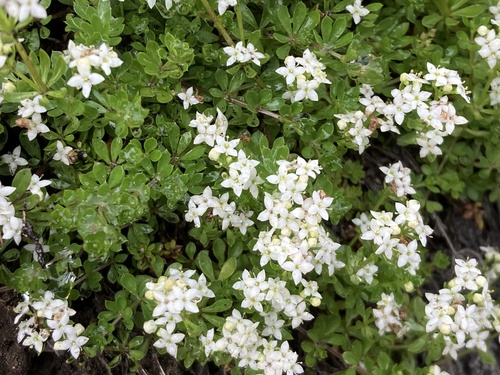
Heath Bedstraw
Galium saxatile
A delicate carpet of stars for the forest floor, Heath Bedstraw transforms acidic heaths into a sea of white every summer. This resilient perennial is a master of survival in poor soils, providing a critical nectar source for the garden's smallest visitors.
Quick Identification
Size
Height of 10-25 cm (4-10 inches); forms mats spreading up to 50 cm (20 inches) wide
Colors
Brilliant white flowers; vibrant green foliage that can turn reddish-bronze in autumn
Key Features
- Low-growing, mat-forming growth habit
- Whorls of 6-8 smooth, forward-pointing leaves
- Tiny four-petaled white flowers in loose clusters
- Stems are square in cross-section and hairless
When You’ll See Them
Behavior
Heath Bedstraw is a hardy perennial that plays a vital role in its ecosystem by providing dense ground cover. Unlike its cousin, the 'Sticky Willy' or Cleavers, Heath Bedstraw is smooth to the touch and forms neat, low-lying cushions rather than climbing over other plants. It spreads primarily through a network of creeping runners or stolons, allowing it to colonize acidic patches of ground where other plants might struggle to survive.
In the wild, this plant acts as a miniature hub of activity. During the summer months, its myriad of tiny, star-shaped flowers produces nectar that attracts a diverse range of pollinators, particularly hoverflies and small solitary bees. While it doesn't move in the way animals do, it exhibits 'behavior' through its growth response to light, quickly filling gaps in the turf to maximize photosynthesis before larger ferns or grasses can overshadow it.
EverydayEarth exclusive
Camera Tips
Capturing the delicate beauty of Heath Bedstraw requires a different approach than filming wildlife. To get the best results, place your camera on a ground-level mount or a very low tripod. Because this species forms dense mats, a 'worm's-eye view' creates a stunning forest-like perspective of the tiny white blooms. If your AI camera has a macro mode or adjustable focus, set it to a range of 10-30cm to capture the intricate detail of the four-petaled flowers and the symmetrical leaf whorls.
Timing is everything for plant photography. The best lighting occurs during the 'golden hours'—shortly after sunrise or before sunset—when the soft light prevents the white petals from appearing 'blown out' or overexposed. However, if you are looking to capture the insects that frequent the bedstraw, midday sun provides the high shutter speeds necessary to freeze the motion of hovering flies and bees. Avoid windy days if possible, as the slender stems of the bedstraw will sway, causing motion blur in close-up shots.
Consider setting your camera to time-lapse mode over a period of 48 hours. This allows you to witness the 'circadian rhythm' of the plant as the flowers open and close and the leaves adjust their angle to the sun. Since this plant doesn't move, you can use it as a 'natural lure' for other wildlife; place the camera near a patch of bedstraw in a heathland setting to capture ground-dwelling birds like Meadow Pipits or insects that use the mat for cover.
For the best seasonal shots, monitor your backyard or local trail starting in late May. Once the white 'foam' of flowers appears, that is your window for peak activity. If you are using a trail camera, ensure it is positioned in a spot with high contrast—bedstraw looks magnificent against a backdrop of dark peat or green moss, which helps the white flowers pop in the final image.
Similar Species
Species that look similar or are commonly confused with Heath Bedstraw.
Frequently Asked Questions
Record Heath Bedstraw at your habitat
Connect a camera to start building your own species record — AI identifies every visitor automatically.